


Peoplecert MSP-Practitioner Certification Exam Dumps with 135 Practice Test Questions
New MSP-Practitioner Exam Dumps with High Passing Rate
Peoplecert MSP-Practitioner Exam Syllabus Topics:
| Topic | Details |
|---|---|
| Topic 1 |
|
| Topic 2 |
|
| Topic 3 |
|
| Topic 4 |
|
| Topic 5 |
|
NEW QUESTION # 67
Which of the following is a Governance document?
- A. Quality and assurance strategy
- B. Blueprint
- C. Project Dossier
- D. Risk Register
Answer: A
NEW QUESTION # 68
The programme has successfully completed all projects and work according to the delivery plan and is in the
'close the programme' process. All internal staff, who had worked on the programme, must now be transferred back into business as usual roles.
Which role should be responsible for managing these activities?
- A. Programme manager
- B. Senior responsible owner
- C. Sponsoring group members
- D. Business change manager
Answer: A
Explanation:
Comprehensive and Detailed 200 to 250 words of Explanation From Exact Extract of project- programme-and-portfolio-management of 5th Edition MSP:
The 'Close the programme' process involves the orderly decommissioning of the programme's infrastructure, including its people, assets, and technology. While the SRO is accountable for the closure, the Programme Manager is the role responsible for the practical execution of these activities.
Option C is correct because the Programme Manager's remit includes the "management of the programme team" and the "decommissioning of the programme's organization." Managing the transfer of internal staff back into Business As Usual (BAU) roles is a management task that requires coordination with HR and functional line managers. The Programme Manager must ensure that staff are released in a way that doesn't leave the programme with "resource gaps" during the final administrative wrap-up, while also ensuring the organization reabsorbs its talent effectively. This falls under the Programme Manager's responsibility for the Organization Theme, specifically the aspect of managing the programme's human resources throughout the lifecycle, from the initial "Plan progressive delivery" through to final closure. The BCM (Option D) focuses on the embedding of benefits in the business, not the management of the programme's internal delivery team.
NEW QUESTION # 69
Three pieces of information should be documented in the information approach section of the programme strategy. In which section should this information be documented?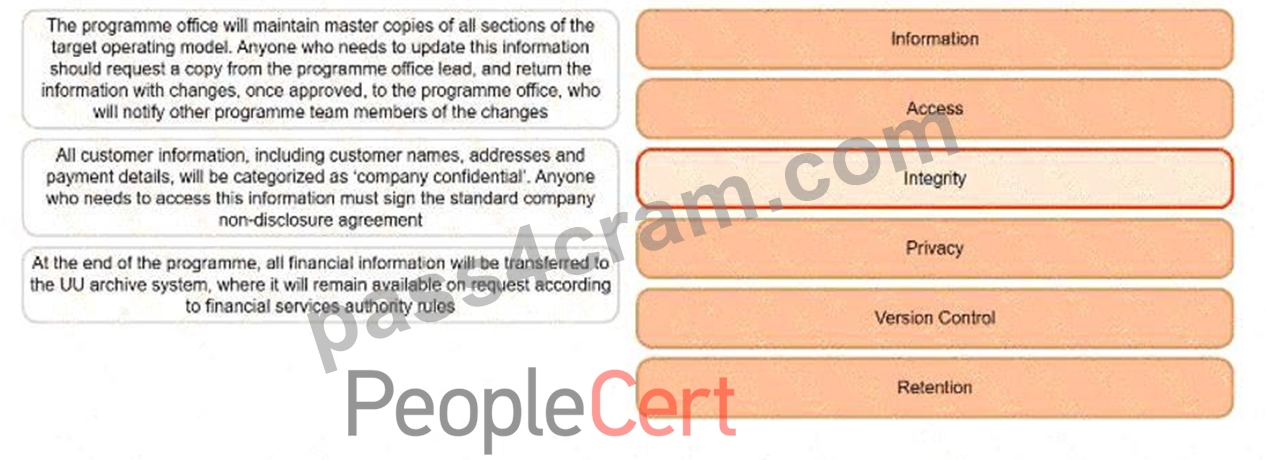
Answer:
Explanation: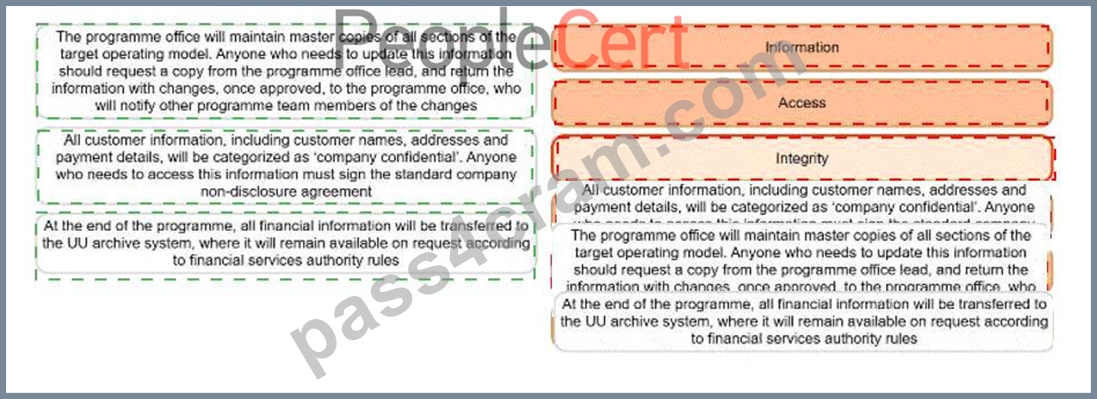
Explanation:
Information
Section
The programme office will maintain master copies of all sections of the TOM. Requests for updates must be approved before being notified to the team Version Control All customer information... will be categorized as 'company confidential'. Anyone needing access must sign the standard company NDA Privacy At the end of the programme, all financial information will be transferred to the UU archive system...
available on request
Retention
Controlling master copies and approving updates is the definition of Version Control. Handling sensitive personal data and NDAs falls under Privacy. Archiving and long-term availability post-programme is the focus of Retention
NEW QUESTION # 70
Who is accountable for confirming programme closure?
- A. Sponsoring group
- B. Programme Manager
- C. SRO
- D. BCM
Answer: C
NEW QUESTION # 71
During the programme, there will be a series of voluntary and compulsory redundancies. The COO believes there is a possibility that UU could lose many of its very highly skilled and knowledgeable staff as a result.
How should this information be managed when applying the 'decisions' theme to the 'embed the outcomes' process?
- A. As an unintended consequence with increased assurance activities to monitor the situation
- B. As a dis-benefit with activities to minimize the effects of skilled labour leaving the organization
- C. As a benefit with activities to maximize the cost savings resulting from additional highly paid staff leaving
- D. As a risk by offering more attractive employment contracts to retain these highly skilled staff
Answer: A
Explanation:
Comprehensive and Detailed 200 to 250 words of Explanation From Exact Extract of project- programme-and-portfolio-management of 5th Edition MSP:
The Decisions Theme in MSP 5th Edition involves monitoring the impact of the transformation and responding to emerging information. During the 'Embed the outcomes' process, the programme must look for unintended consequences-outcomes of the change that were not part of the original design but have an impact (usually negative) on the organization.
The loss of critical, highly skilled staff during a redundancy process is a classic unintended consequence.
While the redundancies themselves were a planned output to reduce costs, the "brain drain" of key talent is a side effect that could damage the long-term health of the business. Option A is the correct answer because MSP 5th Edition guidance states that such consequences should be managed by increasing monitoring and assurance to understand the scale of the impact. This allows the Programme Board to decide if corrective action is needed. While it could be viewed as a dis-benefit (Option C), the "decisions" theme specifically looks at these emerging impacts as things that need to be tracked and evaluated through the governance structure. By treating it as an unintended consequence, the programme can use its assurance mechanisms to provide the SRO with the data needed to make a strategic choice, such as adjusting the retention strategy or the pace of the remaining redundancies.
NEW QUESTION # 72
Which of following is not responsibility of Programme Office?
- A. Providing regular updates on progress to SRO
- B. Risk and Issue tracking
- C. Repository of programme information
- D. Ensuring the control and management frameworks are effectively implemented
Answer: A
Explanation:
Providing regular progress updates to the Senior Responsible Owner (SRO) is the responsibility of the Programme Manager, not the Programme Office. The Programme Office supports by maintaining information repositories, tracking risks and issues, and ensuring control frameworks are implemented. The MSP Practitioner clarifies: "Programme manager provides regular updates to SRO," distinguishing the oversight and reporting role of the Programme Manager from the administrative and support role of the Programme Office.
NEW QUESTION # 73
During Tranche 1, the Call Centre Manager had played an active role in the programme as a BCM. However, at the end of the tranche, it was decided that they were not required during Tranche 2. In addition, the CTO was appointed as a new BCM for Tranche 2.
Which principle is being applied by the 'organization' theme, and why?
- A. Align with priorities, because the new BCM is able to provide support to operations to deliver the Tranche 2 outcomes
- B. Lead with purpose, because the appointment of the new BCM should result in more integrated decisionmaking in Tranche 2
- C. Align with priorities, because the appointment of the new BCM shows senior commitment to Tranche 2
- D. Lead with purpose, because the new BCM has a more senior role in UU and will be able to lead the work in Tranche 2
Answer: A
Explanation:
Comprehensive and Detailed 200 to 250 words of Explanation From Exact Extract of project- programme-and-portfolio-management of 5th Edition MSP:
The 'Align with priorities' principle ensures that the programme structure and its resources remain focused on the current needs of the business as it moves through the transformational flow. The Organization Theme supports this by ensuring that the right people are in the right roles at the right time. Unlike project management roles, MSP roles-specifically the Business Change Manager (BCM)-can and should change as the programme moves between tranches.
In this scenario, Tranche 2 likely involves technical or systems-led changes (indicated by the appointment of the Chief Technology Officer as BCM). Option C is the correct answer because the BCM's primary responsibility is to bridge the gap between the programme and the business operations to ensure that outcomes are delivered and benefits are realized. By changing the BCM to reflect the specific focus of Tranche 2, the programme ensures that the person with the most relevant operational authority and "priority" alignment is leading the transition. This flexibility is a core strength of the MSP framework, allowing the programme to adapt its leadership to the specific nature of the work being performed in different stages of the lifecycle.
NEW QUESTION # 74
Which of following is a key attribute for a SRO?
- A. Good knowledge of project management approaches
- B. Should represent a relevant business area
- C. Have access to and credibility with key stakeholders
- D. Have ongoing operational responsibilities
Answer: C
Explanation:
A key attribute for the Senior Responsible Owner (SRO) is having access to and credibility with key stakeholders because the SRO plays a pivotal role in stakeholder management and programme accountability.
The MSP Practitioner notes, "This attribute is necessary as SRO is also involved in stakeholder management," emphasizing that SRO's influence and stakeholder credibility are critical to programme success.
NEW QUESTION # 75
Which of the following statements is FALSE?
- A. The SRO is appointed by the Sponsoring Group.
- B. The SRO is likely to be a peer of the Sponsoring Group.
- C. The SRO must have enough seniority to take on accountability for the programme delivery.
- D. The SRO acts as the Project Executive on all the Project Boards.
Answer: D
Explanation:
The false statement here is that the SRO acts as the Project Executive on all the Project Boards. The MSP Practitioner explicitly clarifies that the SRO does not take on this project-level responsibility. Instead, the SRO's role is to provide overall accountability for the programme and to ensure the programme delivers its intended outcomes and benefits.
The SRO holds a senior position with enough authority to make decisions and secure resources and is typically a peer of the Sponsoring Group to ensure alignment with corporate strategy. The Sponsoring Group appoints the SRO to oversee the programme's governance and delivery effectively.
Project Executives, in contrast, represent individual projects within the programme and report to the SRO via the programme governance structure. They focus on delivering specific project outputs, while the SRO's responsibility is to coordinate these efforts to achieve strategic benefits.
This distinction is vital to MSP's governance architecture: it prevents the SRO from being burdened with operational project detail, allowing focus on strategic oversight, stakeholder engagement, and benefit realization.
The MSP Practitioner states: "SRO doesn't act as a project representative," underscoring the clear division between programme and project governance to maintain effective control and leadership throughout the programme lifecycle.
NEW QUESTION # 76
POTI model is part of which governance theme?
- A. Risk and issue management
- B. Blueprint
- C. Business Case
- D. Vision
Answer: B
Explanation:
The POTI (Projects, Operations, Teams, and Infrastructure) model is part of the Blueprint governance theme.
It defines the high-level scope and structure of the blueprint, outlining how projects, operational activities, teams, and infrastructure work together to deliver transformation.
The MSP Practitioner confirms: "POTI model defines scope blueprint," situating it firmly within the Blueprint theme that describes the future state and the means to achieve it.
Understanding POTI helps in mapping and managing the components necessary for successful delivery of programme benefits within the defined future organizational state.
NEW QUESTION # 77
UU has always used a linear project management methodology in the past with varying degrees of success.
During the 'design the outcomes' process, UU has decided to trial an agile approach to deliver projects throughout Tranche 1.
Which theme is being applied to the 'design the outcomes' process?
- A. The 'structure' theme is being applied by using an agile delivery method to a complex piece of work
- B. The 'design' theme is being applied by deliberately designing the work to make use of an iterative approach
- C. The 'knowledge' theme is being applied by making use of lessons from their previous agile projects
- D. The 'decisions' theme is being applied by coming to a conclusive decision to use an agile approach for delivery
Answer: B
Explanation:
Comprehensive and Detailed 200 to 250 words of Explanation From Exact Extract of project- programme-and-portfolio-management of 5th Edition MSP:
The Design Theme in MSP 5th Edition is not limited to the technical architecture of the solution; it also encompasses the design of the delivery approach and the path to the future state. According to the MSP 5th Edition guidance, during the 'Design the outcomes' process, the programme must determine the most effective lifecycle for its constituent projects and workstreams. This involves deciding whether a linear, iterative (agile), or hybrid approach is most suitable for the nature of the change.
In this scenario, UU's decision to trial an agile approach is a fundamental design choice. Option D is the correct answer because the Design Theme is responsible for defining how the programme will transition from the current state to the target operating model. By choosing an iterative approach, the programme is
"designing" the work to allow for rapid feedback, flexibility, and incremental value delivery. While this decision involves a "choice" (Option B), the MSP framework specifically categorizes the selection of delivery methodologies and lifecycles under the Design Theme because it shapes the entire strategy for how the outcomes will be realized. This alignment ensures that the delivery method matches the complexity and uncertainty of the programme's objectives, which is a key requirement of the Design Theme's focus on creating a viable and effective blueprint for transformation.
NEW QUESTION # 78
The programme is now in the 'close the programme' process. All the planned training from the Training Project has been completed. However, it is too early to tell how much impact the training will have on service to customers. This will need to be monitored during normal business operation.
Which theme is MOST relevant to this situation?
- A. Knowledge
- B. Design
- C. Organization
- D. Structure
Answer: A
Explanation:
Comprehensive and Detailed 200 to 250 words of Explanation From Exact Extract of project- programme-and-portfolio-management of 5th Edition MSP:
The Knowledge Theme in MSP 5th Edition is not only about the information used during the programme but also about the knowledge and data that must persist after the programme has closed. A key element of this theme is Benefit Realization, which often continues long after the programme's formal closure.
Option B is the correct answer. The situation described involves the long-term monitoring of a benefit (improved service to customers) that resulted from a programme output (the training). According to MSP 5th Edition, when a programme closes, the responsibility for ongoing benefit monitoring and the capture of
"lessons learned" must be handed over to the permanent organization. The Knowledge theme ensures that the frameworks for measuring these impacts (the Benefit Realization Plan) are in place and that the
"knowledge" of how to measure success is transferred to the Business Change Managers or operational leads. This ensures that the organization continues to track the value of the investment even after the programme team has disbanded. This focus on post-closure data and the persistence of information for future learning is a core pillar of the Knowledge theme within the MSP framework.
NEW QUESTION # 79
Which of the below is not a critical organizational element?
- A. Recruitment Policy
- B. Delivery mechanism for change
- C. Business as usual
- D. Corporate strategy
Answer: A
NEW QUESTION # 80
MSP is best suited for which programme?
- A. Technically complex but with defined outputs
- B. Simple programme with defined outcomes and strong governance in place
- C. Programme for long term societal change
- D. Launching new products
Answer: C
Explanation:
MSP is most suited for programmes characterized by high ambiguity, such as those involving long-term societal or political change. These programmes often have evolving objectives and require flexible governance and transformational approaches.
The MSP Practitioner states: "MSP is best suited for programmes which have high ambiguity," indicating its strength in managing complex, uncertain environments where outcomes may not be clearly defined at outset.
While MSP can be applied to technically complex projects, its focus on benefits realization, stakeholder engagement, and transformational flow makes it ideal for complex societal or political programmes where adaptability and governance are critical.
NEW QUESTION # 81
Which of following is NOT part of delivering the capability?
- A. Governance: Manage and control delivery
- B. Start Projects
- C. Align projects with benefits realization
- D. Gateway reviews
Answer: D
Explanation:
Gateway reviews are not part of delivering the capability but are governance checkpoints that occur at specific programme milestones, including the beginning of the programme, key decision points, and closure.
The MSP Practitioner explains: "Gateway reviews happen at beginning of programme, Key decision points of programme and closure of programme." These reviews are formal assessments to validate readiness, progress, and compliance with governance before major transitions, tranche approvals, or programme closure.
Delivering the capability primarily involves initiating projects, managing their delivery under governance frameworks, and ensuring alignment between project outputs and benefit realization. Governance during delivery includes managing risks, issues, and quality controls to ensure outputs are produced to specification.
Gateway reviews are designed to provide independent assurance and decision points but are external to the ongoing activities of capability delivery. Recognizing this distinction helps maintain clarity of roles and processes within programme management, ensuring focused effort on delivery while maintaining appropriate oversight.
NEW QUESTION # 82
Which of the following is Not a core element of successful communication?
- A. Message Clarity and consistency
- B. Feedback Collection system
- C. Identifying correct people to communicate
- D. Stakeholder identification and analysis
Answer: C
Explanation:
While identifying the correct people to communicate with is important, MSP does not list it as one of the four core elements of successful communication.
The MSP Practitioner outlines the four core elements as:
a) Stakeholder identification and analysis
b) Message Clarity and consistency
c) Effective system of message delivery
d) Feedback Collection system
These elements ensure messages are targeted, clear, consistently delivered, and that feedback is captured to improve communication.
Misidentifying core communication elements can weaken engagement efforts, so focusing on these pillars supports stronger communication outcomes throughout the programme lifecycle.
NEW QUESTION # 83
In Managing the Tranches, which role is responsible for preparing for the next tranche?
- A. The Programme Board
- B. The Benefits Realization Manager
- C. The Programme Office
- D. The Programme Manager
Answer: D
Explanation:
The Programme Manager holds responsibility for preparing for the next tranche in the programme lifecycle.
This involves planning, coordination, and ensuring all necessary resources, approvals, and governance arrangements are in place for the tranche to proceed smoothly.
The MSP Practitioner clearly states: "Programme manager is responsible for preparing for next tranche," highlighting the Programme Manager's central role in tranche delivery, risk mitigation, stakeholder communication, and readiness activities.
Preparation for the next tranche includes refining project dossiers, updating the Business Case if necessary, coordinating with the Benefits Realization Manager and other roles, and ensuring that lessons learned from the previous tranche inform future work. This continuous cycle of preparation and delivery ensures programme adaptability, control, and alignment with strategic objectives.
The Programme Board provides governance and approval but delegates the operational responsibilities to the Programme Manager. The Programme Office supports through administrative functions, and the Benefits Realization Manager focuses on benefit tracking rather than tranche planning.
NEW QUESTION # 84
For a business transformation programme, which of scenarios will lead to high probability of success?
- A. New products or services
- B. Process change affecting technology and structures
- C. Internal, external and customer behavior
- D. Changing historical work practices
Answer: B
Explanation:
The probability of success is higher when programme requirements are well-defined and clearly understood.
MSP Practitioner states: "Probability is high when requirements are well defined and clearly understood.
Clear specifications of output increases the probability of success." Process changes affecting technology and structures typically have clearer specifications and boundaries, making successful delivery more likely compared to changes driven by complex behaviors or historical practices.
NEW QUESTION # 85
Which of following is part of critical benefits validation test?
- A. Currency
- B. Accurate
- C. Attribution
- D. Availability
Answer: C
NEW QUESTION # 86
In delivering the capability, which role is responsible for aligning projects with programme objectives?
- A. Programme Manager
- B. SRO
- C. BCM
- D. Programme Office
Answer: A
NEW QUESTION # 87
......
Get MSP-Practitioner Braindumps & MSP-Practitioner Real Exam Questions: https://www.pass4cram.com/MSP-Practitioner_free-download.html
Peoplecert MSP-Practitioner Actual Questions and Braindumps: https://drive.google.com/open?id=1fbjrPwgKrGPTW9inRupNyA_z1h-lJBnN