


Passing Huawei H12-725_V4.0 Exam Using 2026 Practice Tests
H12-725_V4.0 Study Guide Brilliant H12-725_V4.0 Exam Dumps PDF
Huawei H12-725_V4.0 (HCIP-Security V4.0) Certification Exam is a professional accreditation designed to validate an individual's expertise in the field of Huawei security technology. The HCIP-Security V4.0 certification is intended for security professionals who wish to deepen their knowledge and skills in designing and deploying secure network solutions using Huawei technologies.
NEW QUESTION # 10
Which of the following statements is true about the outgoing traffic in the firewall virtual system?
- A. Traffic from the private network interface to the public network interface is limited by the outbound bandwidth.
- B. Traffic from the private network interface to the public network interface is limited by the inbound bandwidth.
- C. Traffic from the public network interface to the private network interface is limited by the outbound bandwidth.
- D. Traffic from the public network interface to the private network interface is limited by the inbound bandwidth.
Answer: A
Explanation:
Comprehensive and Detailed Explanation:
* Inbound bandwidth= Trafficenteringthe firewall.
* Outbound bandwidth= Trafficleavingthe firewall.
* Correct answer:
* A. Private # Public traffic is controlled by outbound bandwidth.
* Why are the other options incorrect?
* Bis incorrect because public # private traffic is controlled byinbound bandwidth, not outbound.
* Cis incorrect because inbound bandwidth does not apply to private # public traffic.
* Dis incorrect because public # private traffic is controlled by inbound bandwidth.
HCIP-Security References:
* Huawei HCIP-Security Guide # Firewall Virtual System Bandwidth Control
NEW QUESTION # 11
iMaster NCE-Campus has a built-in LDAP module that enables it to function as an LDAP server to interconnect with access devices through LDAP.
- A. FALSE
- B. TRUE
Answer: A
Explanation:
Comprehensive and Detailed Explanation:
* iMaster NCE-Campus does not have a built-in LDAP server.Instead, it integrates with external authentication servers such as:
* RADIUS servers
* Active Directory (AD) with LDAP
* HWTACACS servers
* Why is this statement false?
* iMaster NCE-Campus can connect to LDAP but does not act as an LDAP server itself.
HCIP-Security References:
* Huawei HCIP-Security Guide # iMaster NCE-Campus Authentication Integration
NEW QUESTION # 12
In SSL VPN, the firewall performs access authorization and control based on which of the following dimensions?
- A. Port number
- B. Role
- C. IP address
- D. MAC address
Answer: B,C
Explanation:
Comprehensive and Detailed Explanation:
* SSL VPN authorization is role-based:
* Role-based policiesdetermine user permissions.
* IP-based access controlensures users connect from allowed networks.
* Why are B and C incorrect?
* SSL VPN does not authenticate based on MAC address or port number.
HCIP-Security References:
* Huawei HCIP-Security Guide # SSL VPN Access Control
NEW QUESTION # 13
Sort the intrusion prevention steps in sequence based on the working mechanism of the firewall device.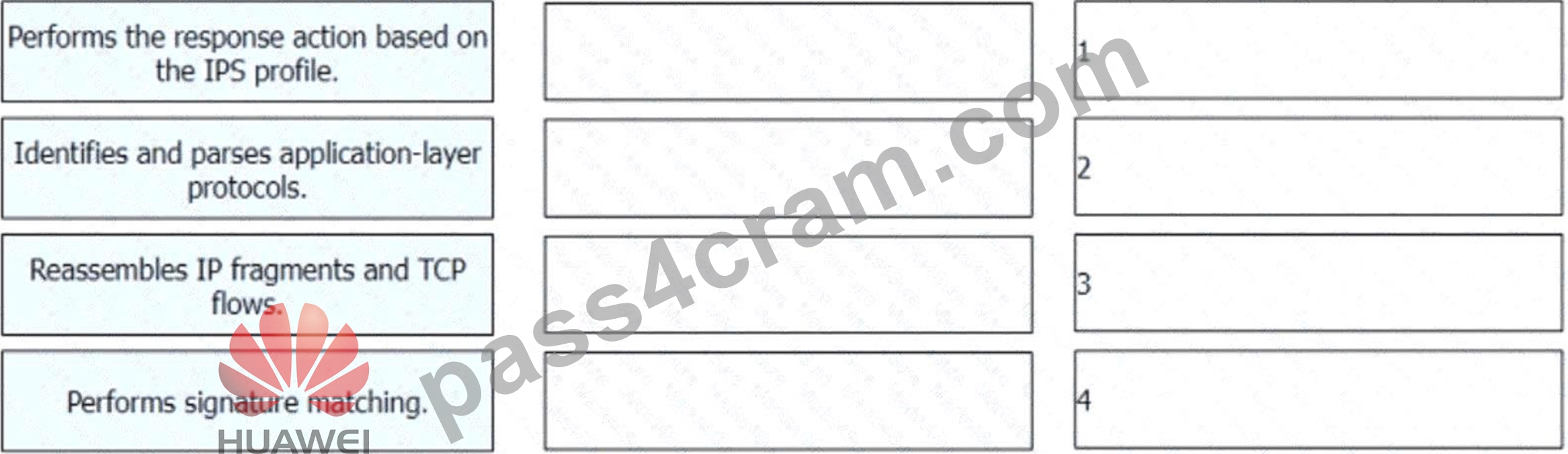
Answer:
Explanation: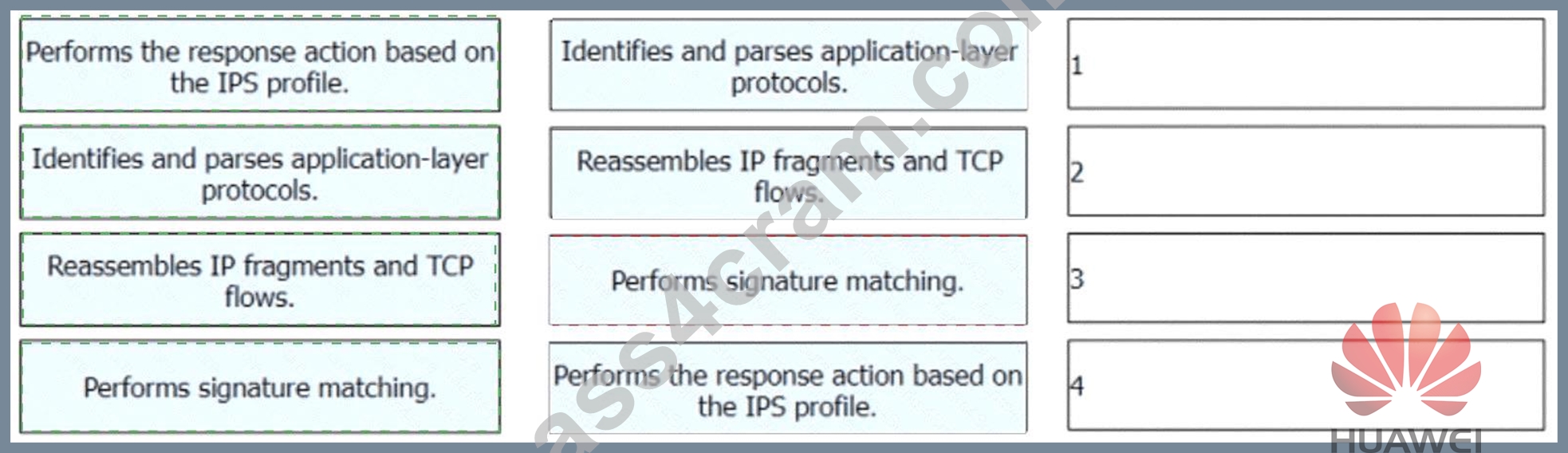
Explanation:
Intrusion Prevention Systems (IPS) in firewalls follow amulti-step processto detect and mitigate threats. The steps occur in a logical sequence:
1##Step 1: Identifies and Parses Application-Layer Protocols
* The firewall firstidentifies the protocol being used(e.g., HTTP, FTP, DNS, SMTP).
* Parsing the protocol helps the IPS engineunderstand how the data is structuredand what types of attacks might be embedded.
* This step is crucial for detectingprotocol-based attackslike SQL injection or cross-site scripting (XSS).
2##Step 2: Reassembles IP Fragments and TCP Flows
* Attackers oftensplit malicious payloads across multiple packetsto evade detection.
* The firewallreassembles fragmented packets and TCP flowsto reconstruct the full data stream.
* This step is critical for detectingevasion techniques such as fragmented attacks or out-of-order packet attacks.
3##Step 3: Performs Signature Matching
* Once the full data stream is reassembled, the IPScompares it against known attack signatures.
* Signature matching helps detect:
* Malware patterns(e.g., botnets, Trojans).
* Exploits targeting vulnerabilitiesin software and operating systems.
* Firewalls usepredefined signature databasesthat are regularly updated.
4##Step 4: Performs the Response Action Based on the IPS Profile
* If an attack is detected, the firewall takes anaction based on the IPS policy:
* Block the traffic(drop malicious packets).
* Alert the administrator(generate logs and alerts).
* Rate-limit traffic(slow down potential attack sources).
* Theresponse mechanism is customizablebased on security requirements.
NEW QUESTION # 14
Before configuring DDoS attack defense, you must configure different thresholds for defense against different types of attacks. Each threshold can be considered an upper limit for normal network traffic.
When the rate of traffic exceeds the pre-configured threshold, the firewall considers it to be attack traffic and takes a corresponding action to defend against it.
- A. FALSE
- B. TRUE
Answer: B
Explanation:
Comprehensive and Detailed Explanation:
* DDoS defense mechanisms rely on threshold settingsto distinguish between normal and attack traffic.
* Thresholds define:
* Maximumallowedtraffic volume.
* When exceeded, firewallstrigger mitigation actions(blocking, rate-limiting, etc.).
* Why is this statement true?
* Threshold-based detection is a fundamental part of DDoS mitigation.
HCIP-Security References:
* Huawei HCIP-Security Guide # DDoS Attack Prevention Thresholds
NEW QUESTION # 15
Which of the following is the function of Message 1 and Message 2 during IKEv1 phase-1 negotiation in main mode?
- A. Negotiation of the IKE proposals used between peers
- B. IPsec SA negotiation
- C. Exchange of key-related information (materials used for key generation) using the DH algorithm and generation of keys
- D. Mutual identity authentication
Answer: A
Explanation:
Comprehensive and Detailed Explanation:
* IKEv1 Phase 1 (Main Mode) consists of six messages:
* Messages 1 & 2 # Negotiate security proposals(encryption, authentication, and DH group).
* Messages 3 & 4 # Exchange key-related information.
* Messages 5 & 6 # Perform mutual authentication.
* Why is B correct?
* Messages 1 and 2 negotiate IKE proposalsbetween VPN peers.
HCIP-Security References:
* Huawei HCIP-Security Guide # IKEv1 Main Mode Negotiation
NEW QUESTION # 16
In a Huawei network security environment, which of the following is a key advantage of using HWTACACS over RADIUS for device management authentication?
Options:
- A. HWTACACS does not support accounting, while RADIUS does.
- B. HWTACACS operates over UDP, ensuring faster communication than RADIUS.
- C. HWTACACS provides per-command authorization, allowing different privilege levels for different users.
- D. HWTACACS encrypts only passwords, while RADIUS encrypts the entire payload.
Answer: C
Explanation:
Understanding the Differences Between HWTACACS and RADIUS:
* HWTACACS(Huawei Terminal Access Controller Access-Control System) is aHuawei-enhanced version of TACACS+used forAAA (Authentication, Authorization, and Accounting).
* RADIUS (Remote Authentication Dial-In User Service)is also an AAA protocol but is mainly designed fornetwork access authentication, such asVPNs and wireless authentication.
Why is Option B Correct?
* HWTACACS supports per-command authorization, meaning administrators canassign different command privileges to different users.
* For example, ajunior network engineer may be allowed to view configurations but not modify them
, while asenior engineer has full access.
* RADIUS does not support granular command authorization, as it primarily controlsnetwork access rather than device management.
NEW QUESTION # 17
Which of the following statements is false about RADIUS and HWTACACS?
- A. Both of them use the client/server model.
- B. Both of them use shared keys to encrypt user information.
- C. Both of them support authorization of configuration commands.
- D. Both of them feature good flexibility and extensibility.
Answer: C
Explanation:
Comprehensive and Detailed Explanation:
* RADIUS and HWTACACS are AAA (Authentication, Authorization, and Accounting) protocols, but they have key differences:
* RADIUS# Encrypts only passwords (not the entire message).
* HWTACACS# Encrypts the entire packet, providing better security.
* Command authorization:
* RADIUS does not support command-level authorization.
* HWTACACS supports per-command authorization(used in network device access control).
* Why is C false?
* RADIUS does not authorize configuration commands; HWTACACS does.
HCIP-Security References:
* Huawei HCIP-Security Guide # RADIUS vs. HWTACACS
NEW QUESTION # 18
Which of the following operations can be performed to harden the Windows operating system?(Select All that Apply)
- A. Change the default TTL value.
- B. Restrict the number of users.
- C. Periodically check account permissions.
- D. Cancel default sharing.
Answer: B,C,D
Explanation:
Comprehensive and Detailed Explanation:
* Windows system hardening improves security by reducing attack surfaces.
* Recommended security measures include:
* A. Periodically checking account permissions# Prevents unauthorized access.
* B. Canceling default sharing# Reduces exposure to remote attacks.
* C. Restricting the number of users# Limits access to essential personnel.
* Why is D incorrect?
* Changing the default TTL value does not directly enhance system security.
HCIP-Security References:
* Huawei HCIP-Security Guide # Windows Hardening Best Practices
NEW QUESTION # 19
When Eth-Trunk is deployed for the heartbeat links between firewalls, the Eth-Trunk interface can be configured as a Layer 2 interface as long as the total bandwidth of active links on the Eth-Trunk is greater than 30% of the bandwidth required by service traffic.
- A. FALSE
- B. TRUE
Answer: A
Explanation:
Comprehensive and Detailed Explanation:
* Heartbeat linksbetween firewalls ensuresynchronization and failover.
* Layer 2 or Layer 3 configuration depends on deployment needs, but there isno strict 30% bandwidth rulefor Eth-Trunk heartbeat links.
* Why is this statement false?
* The30% threshold condition is incorrect.
* Eth-Trunk heartbeat links aretypically Layer 3 for better failover and routing control.
HCIP-Security References:
* Huawei HCIP-Security Guide # Firewall High Availability Deployment
NEW QUESTION # 20
Which of the following actions can be performed when the firewall identifies file anomalies?(Select All that Apply)
- A. Allow
- B. Alarm
- C. Block
- D. Delete attachment
Answer: B,C,D
Explanation:
Comprehensive and Detailed Explanation:
* Firewalls with advanced security features(such asIPS, Antivirus, and File Filtering) candetect and respond to file anomalies.
* Actions that can be taken when an anomaly is detected:
* A. Alarm# Generates a log entry and notifies the administrator.
* C. Block# Prevents the file from being transferred.
* D. Delete attachment# Removes malicious attachments from emails.
* Why is B incorrect?
* Allowing a detected malicious file is not a valid security response.
HCIP-Security References:
* Huawei HCIP-Security Guide # File Filtering & IPS Protection
NEW QUESTION # 21
The Common Vulnerability Scoring System (CVSS) is a widely used open standard for vulnerability scoring. It uses a modular scoring system. Which of the following is not included in the CVSS?
- A. Temporal
- B. Environmental
- C. Spatial
- D. Base
Answer: C
Explanation:
Comprehensive and Detailed Explanation:
* CVSS (Common Vulnerability Scoring System)is used toevaluate the severity of security vulnerabilities.
* It consists of three metric groups:
* A. Temporal# Measures how the vulnerability changes over time.
* B. Base# Measures theinherent severityof the vulnerability.
* C. Environmental# Measures the impact based on the user's specific environment.
* Why is D incorrect?
* "Spatial" is not a part of the CVSS scoring system.
HCIP-Security References:
* Huawei HCIP-Security Guide # CVSS and Risk Scoring
NEW QUESTION # 22
Which of the following statements is false about virtual system resource allocation?
- A. Improper resource allocation may prevent other virtual systems from obtaining resources and services from running properly.
- B. Quota-based resources are automatically allocated based on system specifications.
- C. Virtual systems can share and preempt resources of the entire device. Such resources can be manually allocated.
- D. To manually allocate resources to a virtual system, an administrator needs to configure a resource class, specify the guaranteed quota and maximum quota of each resource in the resource class, and bind the resource class to the virtual system.
Answer: B
Explanation:
Comprehensive and Detailed Explanation:
* Virtual system resource allocation can bemanual or shared.
* Manual allocationrequires configuring aresource class, defining aquota, and binding it to a virtual system.
* Why is D false?
* Quota-based resources are not automatically allocated.
* An administrator must defineresource quotas.
HCIP-Security References:
* Huawei HCIP-Security Guide # Virtual System Resource Allocation
NEW QUESTION # 23
In the figure, if 802.1X authentication is used for wired users on the network, the network admission device and terminals must be connected through a Layer 2 network.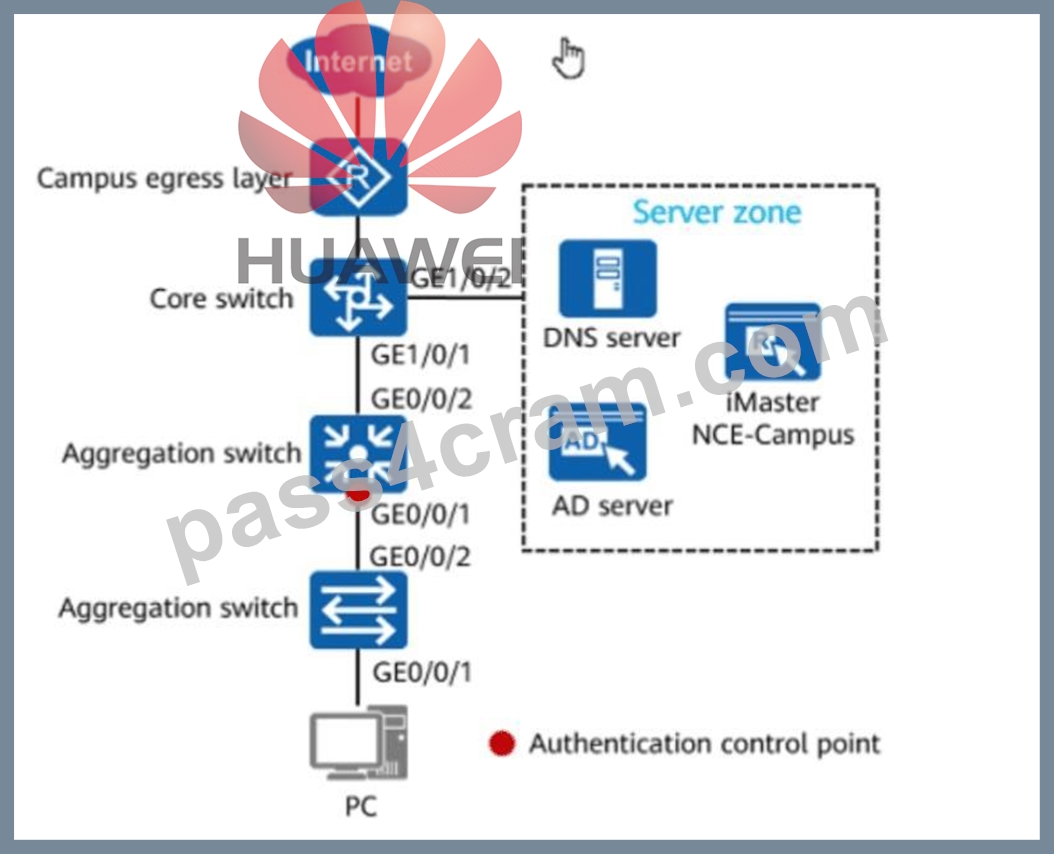
Options:
- A. FALSE
- B. TRUE
Answer: B
Explanation:
Understanding 802.1X Authentication in Wired Networks:
* 802.1X is a port-based network access control (PNAC) protocolthat requires aLayer 2 connection between thesupplicant (PC), the authenticator (switch), and the authentication server (e.g., RADIUS server).
* In wired networks,802.1X authentication occurs at the Ethernet switch (Layer 2 device), which enforces authenticationbefore allowing network access.
Why Must the Network Be Layer 2?
* 802.1X authentication operates at Layer 2 (Data Link Layer) before any IP-based communication (Layer 3) occurs.
* If the authentication device and user terminal were on different Layer 3 networks, the authentication packets (EAPOL - Extensible Authentication Protocol Over LAN)would not be forwarded.
* In the figure, the authentication control point is at theaggregation switch, which means thePC and switch must be in the same Layer 2 domain.
Components of 802.1X Authentication in the Figure:
* Supplicant (PC)# The device requesting network access.
* Authenticator (Aggregation Switch)# The switch controlling access to the network based on authentication results.
* Authentication Server (iMaster NCE-Campus & AD Server)# Verifies user credentials and grants or denies access.
* Layer 2 Connectivity Requirement# ThePC must be in the same Layer 2 networkas the Authenticatorto communicate via EAPOL.
Why "TRUE" is the Correct answer:
* 802.1X authentication is performed before IP addresses are assigned, meaning it can only operate in a Layer 2 network.
* EAPOL (Extensible Authentication Protocol Over LAN) messages are not routableand must stay within a single Layer 2 broadcast domain.
* In enterprise networks,VLAN-based 802.1X authentication is often used, where authenticated users are assigned to a specific VLAN.
HCIP-Security References:
* Huawei HCIP-Security Guide# 802.1X Authentication in Enterprise Networks
* Huawei iMaster NCE-Campus Documentation# Authentication Control and NAC Deployment
* IEEE 802.1X Standard Documentation# Layer 2 Network Authentication
NEW QUESTION # 24
In the figure, enterprise A and enterprise B need to communicate securely, and an IPsec tunnel is established between firewall A and firewall B. Which of the following security protocols and encapsulation modes can meet the requirements of this scenario?
- A. ESP; transport mode
- B. AH+ESP; transport mode
- C. ESP; tunnel mode
- D. AH; tunnel mode
Answer: C
Explanation:
1##Understanding the Scenario:
* Enterprise A and Enterprise B communicate over the Internet through an IPsec tunnel.
* Firewall A and Firewall B establish the tunnelto secure traffic between the enterprises.
* The network includes aSource NAT device, meaning IP headers may be modified.
* The goal is to ensure confidentiality, integrity, and authentication of data transmission.
2##Why ESP (Encapsulating Security Payload)?
* ESP (Encapsulating Security Payload)provides:
* Encryption (Confidentiality)# Protects data from eavesdropping.
* Integrity & Authentication# Ensures data is not modified.
* NAT Traversal Support# Works through NAT devices, unlike AH (Authentication Header).
* ESP is the preferred choice for VPN tunnels over the public Internet.
3##Why Tunnel Mode?
* Tunnel Mode encapsulates the entire original IP packet, including headers and payload,adding a new IP header.
* Advantages of Tunnel Mode:
* Protects both the data and the original IP addresses(important for communication over untrusted networks).
* Used in site-to-site VPNswhere private network addresses need to be hidden.
HCIP-Security References:
* Huawei HCIP-Security Guide# IPsec VPN Fundamentals
* Huawei USG Series Firewall Configuration Guide# IPsec ESP vs. AH
* RFC 4301 (Security Architecture for the Internet Protocol)# ESP and Tunnel Mode Usage
NEW QUESTION # 25
Trojan horses may disclose sensitive information of victims or even remotely manipulate victims' hosts, causing serious harm. Which of the following are the transmission modes of Trojan horses?(Select All that Apply)
- A. The software downloaded from a third-party downloader carries Trojan horses.
- B. Attackers exploit vulnerabilities to break into hosts and install Trojan horses.
- C. A Trojan horse is bundled in a well-known tool program.
- D. A Trojan horse masquerades as a tool program to deceive users to run the program on a host. Once the program is run, the Trojan horse is automatically implanted into the host.
Answer: A,B,C,D
Explanation:
Comprehensive and Detailed Explanation:
* A Trojan horse is a type of malware that disguises itself as a legitimate applicationto trick users into installing it.
* Transmission methods:
* A. Exploiting vulnerabilities# Attackers use system/software vulnerabilities to inject Trojans.
* B. Bundled in software# Trojans are included in cracked software or pirated applications.
* C. Downloaded from third-party sites# Users unknowingly install malware from untrusted sources.
* D. Masquerading as useful software# Fake tools trick users into installation.
* Why are all options correct?
* All listed methods are common ways Trojans spread.
HCIP-Security References:
* Huawei HCIP-Security Guide # Malware & Trojan Horse Attacks
NEW QUESTION # 26
Which of the following statements is false about HTTP behavior?
- A. You can set an alarm threshold and a block threshold to limit the size of the upload file if file upload is allowed.
- B. When the size of the uploaded or downloaded file or the size of the content obtained through the POST operation reaches the alarm threshold, the system generates a log to notify the device administrator and block the behavior.
- C. The POST method of HTTP is commonly used to send information to the server through web pages.For example, use this method when you post threads, submit forms, and use your username and password to log in to a specific system.
- D. When the size of the uploaded or downloaded file or the size of the content obtained through the POST operation reaches the block threshold, the system blocks the uploaded or downloaded file or POST operation.
Answer: B
Explanation:
Comprehensive and Detailed Explanation:
* Threshold settings in firewalls allow administrators to define:
* Alarm threshold# When exceeded, logs are generated.
* Block threshold# When exceeded, the action is blocked.
* Why is B false?
* The alarm threshold does not block traffic; it only generates logs.
* Only the block threshold enforces blocking actions.
HCIP-Security References:
* Huawei HCIP-Security Guide # HTTP Traffic Control
NEW QUESTION # 27
On a WLAN where the WAC has Portal authentication configured, VLAN authorization can be implemented with no additional configuration required. After Portal authentication is complete, the WAC forwards STA traffic based on the authorized VLANs.
- A. FALSE
- B. TRUE
Answer: A
Explanation:
Comprehensive and Detailed Explanation:
* VLAN authorization in Portal authentication requires additional configuration.
* To assign VLANs dynamically:
* RADIUSmust return VLAN attributesafter authentication.
* TheWAC (Wireless Access Controller) must be configured to support dynamic VLAN assignment.
* Why is this statement false?
* VLAN authorization requires RADIUS attributes and WAC configuration-it is not automatic.
HCIP-Security References:
* Huawei HCIP-Security Guide # WLAN & Portal Authentication
NEW QUESTION # 28
Multiple links can be deployed at the egress of an enterprise network to improve network reliability.
- A. FALSE
- B. TRUE
Answer: B
Explanation:
Comprehensive and Detailed Explanation:
* Deploying multiple egress linksensures:
* Redundancy# If one link fails, another remains active.
* Load balancing# Traffic can be distributed across multiple links.
* High availability# Reduces downtime.
* Why is this statement true?
* Enterprise networksbenefit from multiple egress links.
HCIP-Security References:
* Huawei HCIP-Security Guide # Network Redundancy and High Availability
NEW QUESTION # 29
Which of the following statements is false about hot standby networking?(Select All that Apply)
- A. In load-sharing mode, both devices process traffic. Therefore, this mode supports more peak traffic than the active/standby or mirroring mode.
- B. In load-sharing mode, configuration commands can be backed up only from the configuration standby device to the configuration active device.
- C. In load-sharing mode, both firewalls are active. Therefore, if both firewalls synchronize commands to each other, commands may be overwritten or conflict with each other.
- D. In active/standby mode, configuration commands and status information are backed up from the active device to the standby device.
Answer: B,C
Explanation:
Comprehensive and Detailed Explanation:
* Hot standby networkingensureshigh availabilityby keeping a backup firewall ready in case of failure.
* Two main modes exist:
* Active/Standby Mode# One firewall is active, and the other remains standby. Configuration is synchronized fromactive # standby.
* Load-Sharing Mode# Both firewallsprocess traffic simultaneously, improving performance.
* Why is A false?
* InLoad-Sharing Mode, both firewalls are active, butconfiguration synchronization does not cause conflicts. Instead, the firewalls synchronize states properly.
* Why is D false?
* InLoad-Sharing Mode, configuration is always synchronizedfrom the active firewall to the standby firewall, not the other way around.
HCIP-Security References:
* Huawei HCIP-Security Guide # Hot Standby Configuration
* Huawei USG Firewalls High Availability Guide
NEW QUESTION # 30
......
Free H12-725_V4.0 Test Questions Real Practice Test Questions: https://www.pass4cram.com/H12-725_V4.0_free-download.html
View H12-725_V4.0 Exam Question Dumps With Latest Demo: https://drive.google.com/open?id=1-hdYIMYM5nkog39EShmYOknbhw4jT6ir