


[Mar 10, 2024] Fast Exam Updates DEA-C01 dumps with PDF Test Engine Practice
Exam Valid Dumps with Instant Download Free Updates
NEW QUESTION # 11
What is a characteristic of the use of binding variables in JavaScript stored procedures in Snowflake?
- A. Users are restricted from binding JavaScript variables because they create SQL injection attack vulnerabilities
- B. All Snowflake first-class objects can be bound
- C. Only JavaScript variables of type number, string and sf Date can be bound
- D. All types of JavaScript variables can be bound
Answer: C
Explanation:
Explanation
A characteristic of the use of binding variables in JavaScript stored procedures in Snowflake is that only JavaScript variables of type number, string and sf Date can be bound. Binding variables are a way to pass values from JavaScript variables to SQL statements within a stored procedure. Binding variables can improve the security and performance of the stored procedure by preventing SQL injection attacks and reducing the parsing overhead. However, not all types of JavaScript variables can be bound. Only the primitive types number and string, and the Snowflake-specific type sf Date, can be bound. The other options are incorrect because they do not describe a characteristic of the use of binding variables in JavaScript stored procedures in Snowflake. Option A is incorrect because authenticator is not a type of JavaScript variable, but a parameter of the snowflake.connector.connect function. Option B is incorrect because arrow_number_to_decimal is not a type of JavaScript variable, but a parameter of the snowflake.connector.connect function. Option D is incorrect because users are not restricted from binding JavaScript variables, but encouraged to do so.
NEW QUESTION # 12
You as Data engineer might want to consider disabling auto-suspend for a warehouse if?
- A. You require the warehouse to be available with no delay or lag time.
- B. You have a heavy, steady workload for the warehouse.
- C. You have a low, fluctuating workload for the warehouse.
- D. You require the warehouse to be available with delay.
Answer: A,B
Explanation:
Explanation
Automating Warehouse Suspension
Data Engineer might want to consider disabling auto-suspend for a warehouse if:
He/She have a heavy, steady workload for the warehouse.
He/She require the warehouse to be available with no delay or lag time. Warehouse provisioning is generally very fast (e.g. 1 or 2 seconds); however, depending on the size of the warehouse and the availability of compute resources to provision, it can take longer.
If he/she chose to disable auto-suspend, He/she must carefully consider the costs associated with running a warehouse continually, even when the warehouse is not processing queries. The costs can be significant, especially for larger warehouses (X-Large, 2X-Large, etc.).
To disable auto-suspend, Engineer must explicitly select Never in the web interface, or specify 0 or NULL in SQL.
NEW QUESTION # 13
Which ones are the false statements about Materialized Views?
- A. Snowflake does not allow users to truncate materialized views.
- B. Materialized views can be secure views.
- C. Snowflake does not allow standard DML (e.g. INSERT, UPDATE, DELETE) on ma-terialized views.
- D. Clustering a subset of the materialized views on a table tends to be more cost-effective than clustering the table itself.
- E. Materialized views are first-class account objects.
- F. A materialized view can also be used as the data source for a subquery.
Answer: E
Explanation:
Explanation
Materialized views are first-class Database objects & rest of the understandings are true.
NEW QUESTION # 14
What kind of Snowflake integration is required when defining an external function in Snowflake?
- A. Security integration
- B. HTTP integration
- C. API integration
- D. Notification integration
Answer: C
Explanation:
Explanation
An API integration is required when defining an external function in Snowflake. An API integration is a Snowflake object that defines how Snowflake communicates with an externalservice via HTTPS requests and responses. An API integration specifies parameters such as URL, authentication method, encryption settings, request headers, and timeout values. An API integration is used to create an external function object that invokes the external service from within SQL queries.
NEW QUESTION # 15
Bob, a Lead Data Engineer is looking out to get the function definition & queried below statement to check if this function is secure enough to use in his script or not.
select is_secure from information_schema.functions where function_name = 'JOHNFUNCTION'; From the query output he is sure that, Function is secure UDF, what are the way provided by snow-flake to get the function definition of secure UDF?
- A. UDF definition or text, is visible to users via Query Profile (in the web interface).
- B. He can get the secure UDF definition using GET_DDL utility function.
- C. SHOW FUNCTIONS Commands
- D. Declaring a UDF as "secure" hide the definition from Bob & all the required Definition commands will throw error.
Answer: D
NEW QUESTION # 16
The JSON below is stored in a variant column named v in a table named jCustRaw: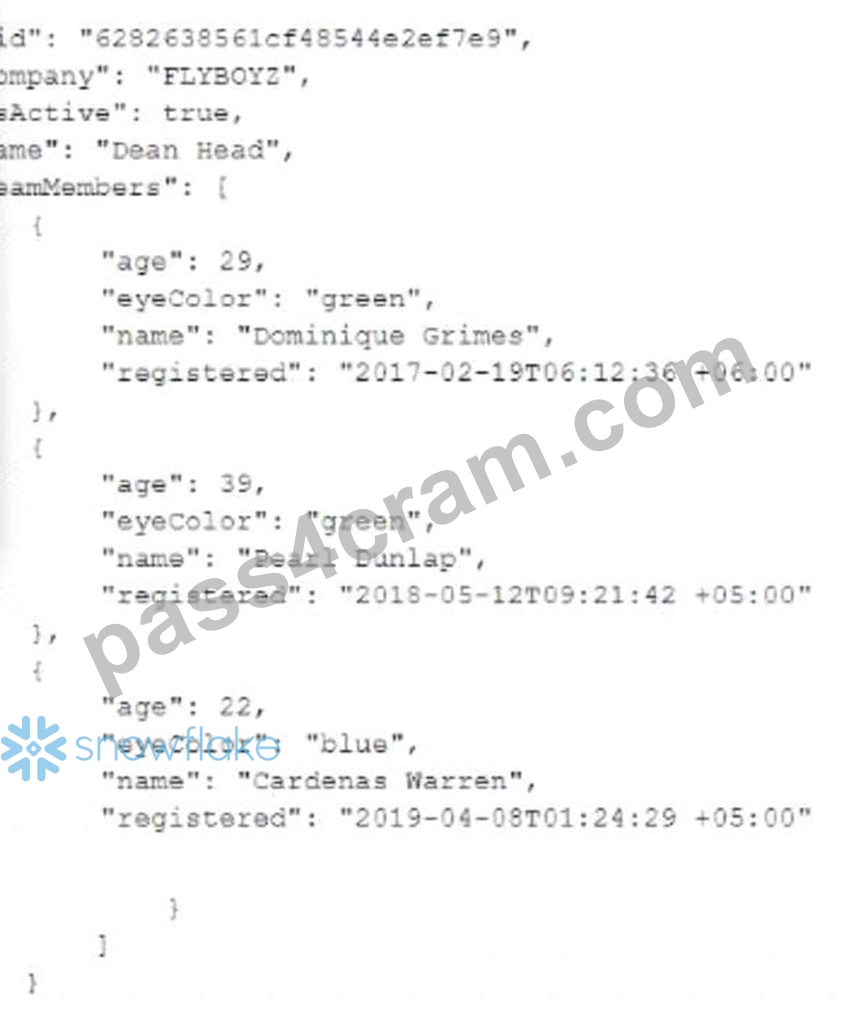
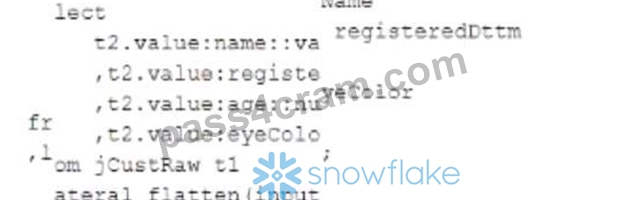
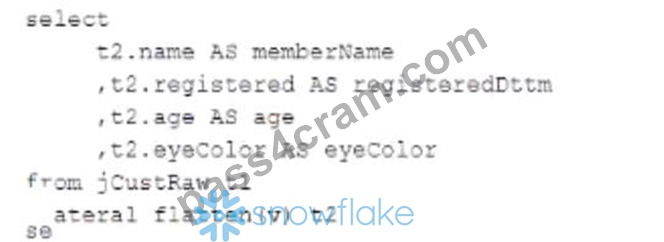
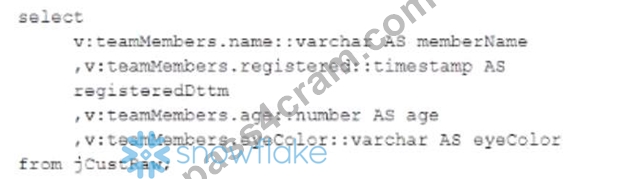
Which query will return one row per team member (stored in the teamMembers array) along all of the attributes of each team member?
- A.

- B.
- C.
- D.
Answer: B
NEW QUESTION # 17
Snowpipe API provides a REST endpoint for defining the list of files to ingest that Informs Snow-flake about the files to be ingested into a table. A successful response from this endpoint means that Snowflake has recorded the list of files to add to the table. It does not necessarily mean the files have been ingested. What is name of this Endpoint?
- A. REST endpoints --> loadHistoryScan
- B. REST endpoints--> insertfiles
- C. REST endpoints --> ingestfiles
- D. REST endpoints --> insertReport
Answer: B
Explanation:
Explanation
The Snowpipe API provides a REST endpoint for defining the list of files to ingest.
Endpoint: insertFiles
Informs Snowflake about the files to be ingested into a table. A successful response from this end-point means that Snowflake has recorded the list of files to add to the table. It does not necessarily mean the files have been ingested. For more details, see the response codes below.
In most cases, Snowflake inserts fresh data into the target table within a few minutes.
To Know more about SnowFlake Rest API used for Data File ingestion, do refer:
https://docs.snowflake.com/en/user-guide/data-load-snowpipe-rest-apis.html#data-file-ingestion
NEW QUESTION # 18
For the most efficient and cost-effective Data load experience, Data Engineer needs to inconsider-ate which of the following considerations?
- A. if the "null" values in your files indicate missing values and have no other special mean-ing, Snowflake recommend setting the file format option STRIP_NULL_VALUES to TRUE when loading the semi-structured data file.
- B. Split larger files into a greater number of smaller files, maximize the processing over-head for each file.
(Correct) - C. Enabling the STRIP_OUTER_ARRAY file format option for the COPY INTO <ta-ble> command to remove the outer array structure and load the records into separate table rows.
- D. Amazon Kinesis Firehose can be convenient way to aggregate and batch data files which also allows defining both the desired file size, called the buffer size, and the wait interval after which a new file is sent, called the buffer interval.
- E. When preparing your delimited text (CSV) files for loading, the number of columns in each row should be consistent.
Answer: B
Explanation:
Explanation
Split larger files into a greater number of smaller files to distribute the load among the compute re-sources in an active warehouse. This would minimize the processing overhead rather than maximize it.
Rest is recommended Data loading considerations.
NEW QUESTION # 19
Which functions will compute a 'fingerprint' over an entire table, query result, or window to quickly detect changes to table contents or query results? (Select TWO).
- A. HASH COMPARE(*)
- B. HASH_AGG(<expr>, <expr>)
- C. HASH_AGG_COMPARE (*)
- D. HASH_AGG(*)
- E. HASH (*)
Answer: B,D
Explanation:
Explanation
The functions that will compute a 'fingerprint' over an entire table, query result, or window to quickly detect changes to table contents or query results are:
HASH_AGG(*): This function computes a hash value over all columns and rows in a table, query result, or window. The function returns a single value for each group defined by a GROUP BY clause, or a single value for the entire input if no GROUP BY clause is specified.
HASH_AGG(<expr>, <expr>): This function computes a hash value over two expressions in a table, query result, or window. The function returns a single value for each group defined by a GROUP BY clause, or a single value for the entire input if no GROUP BY clause is specified. The other functions are not correct because:
HASH (*): This function computes a hash value over all columns in a single row. The function returns one value per row, not one value per table, query result, or window.
HASH_AGG_COMPARE (): This function compares two hash values computed by HASH_AGG() over two tables or query results and returns true if they are equal or false if they are different. The function does not compute a hash value itself, but rather compares two existing hash values.
HASH COMPARE(): This function compares two hash values computed by HASH() over two rows and returns true if they are equal or false if they are different. The function does not compute a hash value itself, but rather compares two existing hash values.
NEW QUESTION # 20
Which of the following security and governance tools/technologies are known to provide native connectivity to Snowflake? [Select 2]
- A. Zepl
- B. ALTR
- C. BIG Squid
- D. Dataiku
- E. Baffle
Answer: B,E
Explanation:
Explanation
Security and governance tools ensure sensitive data maintained by an organization is protected from inappropriate access and tampering, as well as helping organizations to achieve and maintain regula-tory compliance. These tools are often used in conjunction with observability solutions/services to provide organizations with visibility into the status, quality, and integrity of their data, including identifying potential issues.
Together, these tools support a wide range of operations, including risk assessment, intrusion detec-tion/monitoring/notification, data masking, data cataloging, data health/quality checks, issue identi-fication/troubleshooting/resolution, and more.
ALTR & Baffle are correct options here.
NEW QUESTION # 21
Select the Correct statements with regard to using Federated authentication/SSO?
- A. Snowflake supports using MFA in conjunction with SSO to provide additional levels of security.
- B. Snowflake supports using SSO with organizations, and you can use the corresponding URL in the SAML2 security integration.
- C. Snowflake supports SSO with Private Connectivity to the Snowflake Service for Snow-flake accounts on Amazon Web Services (AWS), Microsoft Azure, and Google Cloud Platform.
- D. Snowflake supports multiple audience values (i.e. Audience or Audience Restriction Fields) in the SAML 2.0 assertion from the identity provider to Snowflake.
Answer: A,B,C,D
NEW QUESTION # 22
A Data Engineer is building a set of reporting tables to analyze consumer requests by region for each of the Data Exchange offerings annually, as well as click-through rates for each listing Which views are needed MINIMALLY as data sources?
- A. SNOWFLAKE- DATA_SHARING_USAGE - LISTING_EVENTS_BAILY
- B. SNOWFLAKE.DATA_SHARING_USAGE.LISTING_CONSOKE>TION_DAILY
- C. SNOWFLAKE. DATA_SHARING_USAGE. LISTING_TELEMETRY_DAILy
- D. SNOWFLAKE.ACCOUNT_USAGE.DATA _TRANSFER_HISTORY
Answer: B
Explanation:
Explanation
The SNOWFLAKE.DATA SHARING _USAGE.LISTING_CONSOKE>TION_DAILY view provides information about consumer requests by region for each of the Data Exchange offeringsannually, as well as click-through rates for each listing. This view is the minimal data source needed for building the reporting tables. The other views are not relevant for this use case.
NEW QUESTION # 23
Charles, A Lead Data engineer, with ACCOUNTADMIN role wants to configure the time travel for one of the Schema's object. He setup the MIN_DATA_RETENTION_TIME_IN_DAYS pa-rameter with Value 79 at account level but he figured out that DA-TA_RETENTION_TIME_IN_DAYS is already set with value 81 at account level. What would be the effective minimum data retention period for an object?
- A. 0
- B. 1
- C. There is no such MIN_DATA_RETENTION_TIME_IN_DAYS parameter
- D. 2
Answer: A
Explanation:
Explanation
A user with the ACCOUNTADMIN role can also set the MIN_DATA_RETENTION_TIME_IN_DAYS at the account level. This parameter setting enforc-es a minimum data retention period for databases, schemas, and tables. Setting MIN_DATA_RETENTION_TIME_IN_DAYS does not alter or replace the DA-TA_RETENTION_TIME_IN_DAYS parameter value. It may, however, change the effective data retention period for objects. When MIN_DATA_RETENTION_TIME_IN_DAYS is set at the ac-count level, the data retention period for an object is determined by MAX(DATA_RETENTION_TIME_IN_DAYS, MIN_DATA_RETENTION_TIME_IN_DAYS).
NEW QUESTION # 24
A company built a sales reporting system with Python, connecting to Snowflake using the Python Connector.
Based on the user's selections, the system generates the SQL queries needed to fetch the data for the report First it gets the customers that meet the given query parameters (on average 1000 customer records for each report run) and then it loops the customer records sequentially Inside that loop it runs the generated SQL clause for the current customer to get the detailed data for that customer number from the sales data table When the Data Engineer tested the individual SQL clauses they were fast enough (1 second to get the customers 0 5 second to get the sales data for one customer) but the total runtime of the report is too long How can this situation be improved?
- A. Rewrite the report to eliminate the use of the loop construct
- B. Increase the number of maximum clusters of the virtual warehouse
- C. Define a clustering key for the sales data table
- D. Increase the size of the virtual warehouse
Answer: A
Explanation:
Explanation
This option is the best way to improve the situation, as using a loop construct to run SQL queries for each customer is very inefficient and slow. Instead, the report should be rewritten to use a single SQL query that joins the customer and sales data tables and applies the query parameters as filters. This way, the report can leverage Snowflake's parallel processing and optimization capabilities and reduce the network overhead and latency.
NEW QUESTION # 25
A Data Engineer wants to create a new development database (DEV) as a clone of the permanent production database (PROD) There is a requirement to disable Fail-safe for all tables.
Which command will meet these requirements?
- A. CREATE DATABASE DEV
CLONE PROD
FAIL_SAFE=FALSE; - B. CREATE DATABASE DEV
CLOSE PROD
DATA_RETENTION_TIME_IN_DAYS =0L - C. CREATE TRANSIENT DATABASE DEV
CLONE RPOD - D. CREATE DATABASE DEV
CLONE PROD;
Answer: C
Explanation:
Explanation
This option will meet the requirements of creating a new development database (DEV) as a clone of the permanent production database (PROD) and disabling Fail-safe for all tables. By using the CREATE TRANSIENT DATABASE command, the Data Engineer can create a transient database that does not have Fail-safe enabled by default. Fail-safe is a feature in Snowflake that provides additional protection against data loss by retaining historical data for seven days beyond the time travel retention period. Transient databases do not have Fail-safe enabled, which means that they do not incur additional storage costs for historical data beyond their time travel retention period. By using the CLONE option, the Data Engineer can create an exact copy of the PROD database, including its schemas, tables, views, and other objects.
NEW QUESTION # 26
Streams cannot be created to query change data on which of the following objects? [Select All that Apply]
- A. Directory tables
- B. External tables
- C. Query Log Tables
- D. Standard tables, including shared tables.
- E. Views, including secure views
Answer: C
Explanation:
Explanation
Streams supports all the listed objects except Query Log tables.
NEW QUESTION # 27
Select the incorrect statement while working with warehouses?
- A. Compute resources waiting to shut down are considered to be in "quiesce" mode.
- B. Resizing a suspended warehouse does not provision any new compute resources for the warehouse.
- C. Resizing a warehouse will have any immediate impact on statements that are currently being executed by the warehouse.
- D. Resizing a warehouse to a larger size is useful while loading and unloading significant amounts of data.
Answer: C
Explanation:
Explanation
Resizing a warehouse doesn't have any impact on statements that are currently being executed by the warehouse. When resizing to a larger size, the new compute resources, once fully provisioned, are used only to execute statements that are already in the warehouse queue, as well as all future statements submitted to the warehouse.
NEW QUESTION # 28
If you need to connect to Snowflake using a BI tool or technology, which of the following BI tools and technologies are known to provide native connectivity to Snowflake?
- A. ALATION
- B. PROTEGRITY
- C. SISENSE
- D. SELECT STAR
Answer: C
Explanation:
Explanation
SISENSE is BI tools and technologies which is known to provide native connectivity to Snowflake, Rest of the options given are security & governance tools supported by SnowFlake.
Business intelligence (BI) tools enable analyzing, discovering, and reporting on data to help execu-tives and managers make more informed business decisions. A key component of any BI tool is the ability to deliver data visualization through dashboards, charts, and other graphical output.
For More details around supported BI Tools in Snowflake Ecosystem, do refer the link below:
https://docs.snowflake.com/en/user-guide/ecosystem-bi
NEW QUESTION # 29
A Data Engineer wants to centralize grant management to maximize security. A user needs ownership on a table m a new schema However, this user should not have the ability to make grant decisions What is the correct way to do this?
- A. Revoke grant decisions from the user on the schema.
- B. Revoke grant decisions from the user on the table
- C. Grant ownership to the user on the table
- D. Add the with managed access parameter on the schema
Answer: D
Explanation:
Explanation
The with managed access parameter on the schema enables the schema owner to control the grant and revoke privileges on the objects within the schema. This way, the user who owns the table cannot make grant decisions, but only the schema owner can. This is the best way to centralize grant management and maximize security.
NEW QUESTION # 30
A Data Engineer has created table t1 with datatype VARIANT:
create or replace table t1 (cl variant);
The Engineer has loaded the following JSON data set. which has information about 4 laptop models into the table: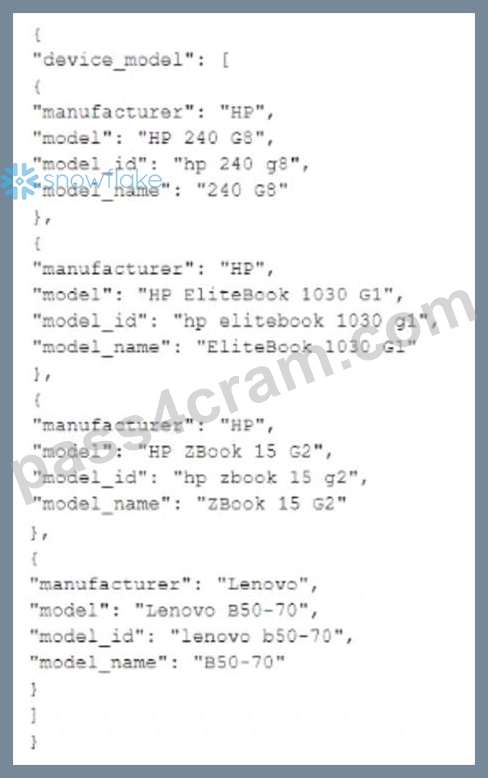
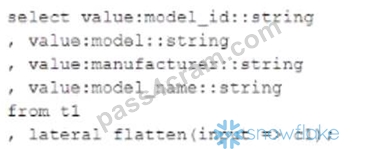
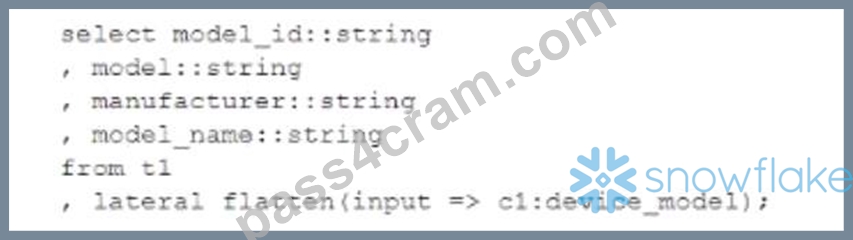
The Engineer now wants to query that data set so that results are shown as normal structured data. The result should be 4 rows and 4 columns without the double quotes surrounding the data elements in the JSON data.
The result should be similar to the use case where the data was selected from a normal relational table z2 where t2 has string data type columns model__id. model, manufacturer, and =iccisi_r.an=. and is queried with the SQL clause select * from t2; Which select command will produce the correct results?
- A.
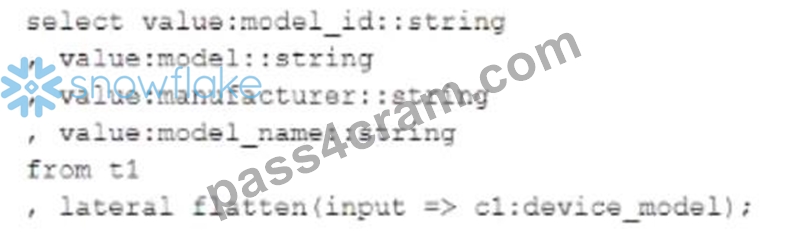
- B.
- C.
- D.
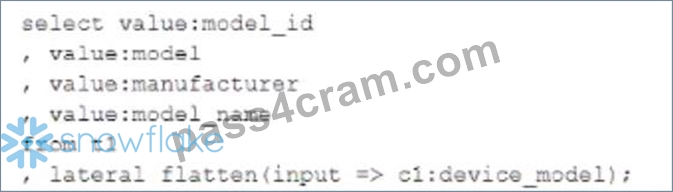
Answer: A
NEW QUESTION # 31
Which one is not the Core benefits of micro-partitioning
- A. Enables extremely efficient DML and fine-grained pruning for faster queries.
- B. Columns are stored independently within micro-partitions, often referred to as colum-nar storage.
- C. Columns are also compressed individually within micro-partitions.
- D. Micro-partitions can overlap in their range of values, helps data skewing.
- E. Snowflake micro-partitions are derived automatically they do not need to be explicitly defined up-front or maintained by users.
Answer: D
Explanation:
Explanation
The benefits of Snowflake's approach to partitioning table data include:
In contrast to traditional static partitioning, Snowflake micro-partitions are derived automatically; they don't need to be explicitly defined up-front or maintained by users.
As the name suggests, micro-partitions are small in size (50 to 500 MB, before compression), which enables extremely efficient DML and fine-grained pruning for faster queries.
Micro-partitions can overlap in their range of values, which, combined with their uniformly small size, helps prevent skew.
Columns are stored independently within micro-partitions, often referred to as columnar storage. This enables efficient scanning of individual columns; only the columns referenced by a query are scanned.
Columns are also compressed individually within micro-partitions. Snowflake automatically de-termines the most efficient compression algorithm for the columns in each micro-partition.
NEW QUESTION # 32
Jackie, a Data engineer advised to his data team members about one of the Role highlighting fol-lows points:
1. Avoid Using the <?> Role for Automated Scripts
2. Avoid Using the <?> Role to Create Objects
Which System defined or Custom Role She is mentioning?
- A. USERADMIN
- B. CUSTOM Role
- C. ACCOUNTADMIN
- D. SYSADMIN
- E. SECURITYADMIN
Answer: C
NEW QUESTION # 33
......
Download DEA-C01 Exam Dumps PDF Q&A: https://www.pass4cram.com/DEA-C01_free-download.html
DEA-C01 Dumps First Attempt Guaranteed Success: https://drive.google.com/open?id=1wBhcBSXZsMewj1Ryiu942ZGTuRgQoFex