


[Jul-2025] Updated Network Appliance NS0-304 Dumps – PDF & Online Engine
NS0-304.pdf - Questions Answers PDF Sample Questions Reliable
Network Appliance NS0-304 Exam Syllabus Topics:
| Topic | Details |
|---|---|
| Topic 1 |
|
| Topic 2 |
|
| Topic 3 |
|
| Topic 4 |
|
| Topic 5 |
|
NEW QUESTION # 76
You are using Cloud Volumes ONTAP for Azure. Your company wants to change hyper scalers. You want to migrate your volumes to Cloud Volumes Service for AWS.
In this scenario, which three steps would you perform to migrate the data? (Choose three.)
- A. Deploy a Cloud Sync data broker in your AWS VPC with Cloud Volumes Service.
- B. Set up an ExpressRoute between Azure and AWS.
- C. Create a VPN between Azure and AWS.
- D. Modify the export policy on your Cloud Volume ONTAP volumes to allow a data broker.
- E. Set up a Direct Connect between AWS and Azure.
Answer: A,B,C
NEW QUESTION # 77
An administrator wants to protect Kubernetes-based applications across both on-premises and the cloud. The backup must be application aware and protect all components and data for the application. The administrator wants to use SnapMirror for disaster recovery.
Which product should the administrator use?
- A. Cloud Backup Service
- B. Astra Control Center
- C. Astra Control Service
- D. NetApp SnapCenter
Answer: C
Explanation:
Astra Control Service is the appropriate NetApp product for protecting Kubernetes-based applications across both on-premises and cloud environments. Astra Control Service is designed to provide application-aware data management, which means it understands the structure and dependencies of Kubernetes applications and can manage them holistically. This includes backup and recovery, application cloning, and dynamic scaling.
While SnapMirror could be used for disaster recovery by replicating data at the storage layer, it does not inherently understand or manage the Kubernetes application layer directly. SnapCenter is primarily focused on traditional data management for enterprise applications on NetApp storage and does not cater specifically to Kubernetes environments. Cloud Backup Service is for backup to the cloud and also does not provide the Kubernetes application awareness required in this scenario.
Thus, Astra Control Service, which integrates deeply with Kubernetes, allows administrators to manage, protect, and move containerized applications and their data across multiple environments, making it the best fit for the described requirements. For detailed information on Astra Control Service's capabilities with Kubernetes applications, refer to the official NetApp Astra Control Service documentation.
NEW QUESTION # 78
Your company has multiple AWS accounts. Including AWS child accounts. Your company wants to use Cloud Insights to monitor the accounts.
According to NetApp documentation, what is the recommended deployment method in this scenario?
- A. Deploy one acquisition unit and one data collector.
- B. Deploy one acquisition unit and multiple data collectors.
- C. Deploy multiple acquisition units and one data collector.
- D. Deploy one acquisition unit and one data collector per child account.
Answer: C
NEW QUESTION # 79
Click the Exhibit button.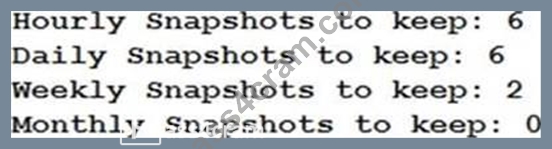
You have set the Snapshot policy shown in the exhibit on your Cloud Volumes Service for AWS.
On the 30th of the month at 10:00 p.m., how many Snapshot copies do you have?
- A. 0
- B. 1
- C. 2
- D. 3
Answer: A
NEW QUESTION # 80
An administrator tries to deploy an SMB volume in Azure NetApp Files in the same region as their AD DS.
The deployment fails with the following error message:
What are two configuration options that must be verified? (Choose two.)
- A. The Global Administrator role is configured.
- B. The Azure subscription has been activated.
- C. The volume is in the same VNet.
- D. The Network Security Groups allows DNS traffic.
Answer: C,D
Explanation:
Based on the error message indicating an issue with querying the DNS server, two critical network-related configurations must be verified to successfully deploy an SMB volume in Azure NetApp Files:
* VNet Configuration:Ensure that the Azure NetApp Files volume and the Active Directory Domain Services (AD DS) are configured within the same Virtual Network (VNet). This is crucial as it ensures that the volume can communicate effectively with the AD DS, which is necessary for SMB authentication and service location.
* Network Security Group (NSG) Settings:Verify that the Network Security Groups associated with the subnet or the VNet where the Azure NetApp Files volume is deployed allows DNS traffic. Specifically, inbound and outbound rules should permit traffic over the ports typically used by DNS (usually TCP/UDP 53). This allows the volume to successfully resolve DNS queries which are essential for integrating with AD DS.
These two checks are aimed at resolving connectivity and DNS resolution issues that are likely causing the deployment to fail. For more detailed troubleshooting and setup instructions, please refer to Azure's official documentation on Network Security Groups and VNet configurations:Azure Networking Documentation.
NEW QUESTION # 81
Your OnCommand Cloud Manager instance has database corruption. You create a new OnCommand Cloud Manager Instance with no data, and your ON1AP instances are still running with no issues.
You want to bring the cloud and on-premises ONTAP instances into the new OnCommand Cloud Manager working environment.
In this scenario, which two actions will satisfy these requirements? (Choose two.)
- A. Promote a load sharing mirror.
- B. Restore the 7zfile.
- C. Import ActiveIQ entitlements.
- D. Discover the ONTAP instances.
Answer: B,D
NEW QUESTION # 82
An administrator cannot create a new volume in Azure NetApp Files. The administrator receives an error that the DNS server is not available. What should the administrator do?
- A. Make sure that the Volume and DNS server are in the same subnet
- B. Confirm the network security groups allow connectivity
- C. Create a VNet service endpoint to the DNS server
- D. Configure subnet delegation for the VNet
Answer: B
Explanation:
When an administrator receives an error that the DNS server is not available while trying to create a new volume in Azure NetApp Files, the first action should be to confirm that the network security groups allow connectivity. Here's the process:
* Check Network Security Group Rules:Verify that the network security group (NSG) associated with the subnet where Azure NetApp Files is located has rules that allow traffic to and from the DNS server, specifically permitting DNS query traffic (typically over port 53 for both TCP and UDP).
* Adjust NSG Settings if Necessary:If the current NSG rules are restrictive and do not allow DNS traffic, modify them to include the necessary allowances for DNS resolution.
* Test Connectivity:After updating the NSG settings, retry the volume creation to see if the DNS issue has been resolved.
For guidance on managing NSGs in Azure, consult the Azure documentation:Azure Network Security Groups.
NEW QUESTION # 83
Your company requires a high level of availability for data services in the cloud. You have selected Cloud Volumes ONTAP HA in AWS to support block-based workloads.
In this scenario, how many AWS availability zones should be used during deployment to provide the highest level of availability?
- A. 0
- B. 1
- C. 2
- D. 3
Answer: D
NEW QUESTION # 84
You want to move cold user data blocks from an AFF A300 active file system to the capacity tier In AWS S3.
In this scenario, how would you configure Fabric Pool?
- A. Set the backup tiering policy.
- B. Set a Snapshot copy tiering policy.
- C. Set a none tiering policy.
- D. Set the auto tiering policy.
Answer: A
NEW QUESTION # 85
An administrator wants to use Cloud Data Sense to monitor all OneDrive accounts in the marketing department. Which two items are required? (Choose two.)
- A. Admin login credentials for the Azure tenant account
- B. User logins for every OneDrive account in the marketing department
- C. Admin login credentials for the OneDrive for Business account
- D. A list of the email addresses for all users whose OneDrive folders are to be scanned
Answer: C,D
Explanation:
To use Cloud Data Sense to monitor all OneDrive accounts in the marketing department, two key items are required:
* A List of the Email Addresses for All Users:This is necessary to identify and access the specific OneDrive accounts belonging to members of the marketing department. Cloud Data Sense needs this information to correctly target and scan the relevant data sets.
* Admin Login Credentials for the OneDrive for Business Account:These credentials are required to grant Cloud Data Sense the necessary permissions to access and scan the OneDrive accounts. Admin credentials ensure that Data Sense can perform scans across multiple user accounts without needing individual user logins.
These requirements ensure that Cloud Data Sense can effectively monitor and analyze the data within OneDrive accounts, providing insights into data usage and compliance.
For additional information on setting up Cloud Data Sense with OneDrive, refer to the NetApp documentation on Cloud Data Sense: NetApp Cloud Data Sense Documentation.
NEW QUESTION # 86
As the site reliability engineer, you have successfully deployed Kubernetes clusters on AWS and Google Cloud Platform using NetApp Kubernetes Service.
In this scenario, what would enable you to manage these clusters through a single management interface?
- A. Istio
- B. NetApp Trident
- C. Federation
- D. Helm Charts
Answer: C
NEW QUESTION # 87
A cloud administrator has a source and a destination volume in different VPCs in the AWS cloud.
The administrator wants to replicate data between the source and destination volumes and avoid ingress and egress charges.
What must the administrator verify to satisfy the requirements?
- A. that the VPC peering connection and the appropriate routing table entries exist
- B. that the source and the destination VPCs are connected to the VPN Gateway
- C. that the source VPC has connectivity to the corporate network
- D. that the destination VPC has connectivity to the corporate
Answer: A
NEW QUESTION # 88
An administrator is preparing to automate firmware updates with the help of Active IQ Digital Advisor. Which automation tool should the administrator use?
- A. Ansible
- B. Terraform
- C. Puppet
- D. Pulumi
Answer: A
Explanation:
To automate firmware updates effectively using Active IQ Digital Advisor, the best tool to use is Ansible.
Here's why:
* Ansible Integration with NetApp:Ansible is widely recognized for its powerful automation capabilities across various IT environments. NetApp provides specific Ansible modules designed to interact with its storage solutions and services, including the automation of firmware updates.
* Active IQ Digital Advisor Integration:Active IQ Digital Advisor offers predictive analytics, actionable intelligence, and proactive recommendations. By using Ansible, administrators can automate the implementation of these recommendations, including firmware updates, to enhance efficiency and reliability in operations.
To implement this, the administrator needs to leverage the NetApp Ansible modules that are specifically designed for storage management tasks. This can be found in the NetApp Automation Store, where administrators can access pre-built playbooks for firmware updates, simplifying the automation process.
For further details and specific implementation steps, please refer to the NetApp Automation Store and the official NetApp documentation on Ansible integration: NetApp Ansible Modules Documentation.
NEW QUESTION # 89
You want to set up data protection from your on-premises AFF A800 to Cloud Volumes ON TAP with
14 days retention and an hourly refresh rate.
In this situation, what should you do to accomplish this task?
- A. Set up a Snapshot with a 1-hour update and a retention of 14 days with ONTAP 9.3.
- B. Set up a SnapVault from source to destination with an 1-hourupdate and retention of 14 days with ONTAP 9.3.
- C. Set up a SnapVault from source to destination with an 1-hour update and retention of 14 days with ONTAP 9.3.
- D. Set up a Snapshot with a 1-hour update and a retention of 14 days with ONTAP 9.4.
Answer: C
NEW QUESTION # 90
Your customer has an E-Series and wants to bock up the volumes to the cloud.
Which two components are required to accomplish this task using SANtricity Cloud Connector? (Choose two.)
- A. Cloud Connector License key for SANtricity
- B. AWS S3 bucket
- C. Windows 2016 Datacenter Edition as a backup host
- D. Red Hat or SUSE Enterprise Linux Server as a backup host
Answer: A,B
NEW QUESTION # 91
Your company has evaluated NetApp SaaS Backup for Microsoft Office 365 with a trial account. In the evaluation period, you used Amazon S3 that was provided by SaaS Backup as the destination for your backup. After evaluation, your company decided to use Bring Your Own Storage (BYOS) as a backup destination.
You determine that none of your previous data is showing up.
What caused this problem?
- A. When upgrading from trial to licensed, data was not preserved.
- B. Changing the destination to BYOS did not migrate the data.
- C. Upgrading from evaluation to licensed reset your SaaS Backup account.
- D. During the change from evaluation to licensed, the access token expired.
Answer: A
NEW QUESTION # 92
You are managing a large NetApp hybrid cloud estate across your business and are experiencing VM performance problems. You are asked to investigate. You need a tool that provides monitoring capabilities and enables you to solve specific issues quickly.
Which NetApp tool would you deploy to satisfy these requirements?
- A. Spot Eco by NetApp
- B. NetApp Cloud Insights
- C. NetApp Cloud Compliance
- D. NetApp Cloud Manager
Answer: B
NEW QUESTION # 93
Your Cloud Volumes ONTAP instance had an unplanned system outage. The instance is not highly available, and you had data loss after the instance came back online.
In this scenario, which OnCommand Cloud Manager provision setting was responsible for this data loss?
- A. Premium Storage
- B. Standard Storage
- C. Normal write speed
- D. High write speed
Answer: D
NEW QUESTION # 94
As the administrator of Cloud Insights, you installed the Acquisition Unit and configured the ONTAP Data Collector. You successfully added an ONTAP 9.5 system for monitoring.
When you add another FAS system, you receive the error message shown below. Error: "7 Mode filers are not supported" In this situation, which statement Is correct?
- A. ONTAP Systems running In 7-Mode are not supported by Cloud Insights
- B. You must use the correct admin level username and password
- C. You must configure the Data Collector for Data ONTAP /-Mode
- D. The communication between the Acquisition Unit and the ONTAP system gets blocked
Answer: D
NEW QUESTION # 95
An administrator deploys FSx for ONTAP as a storage solution in their cloud environment. The administrator cannot mount the file system to their cloud instances in the same VPC.
What should the administrator do?
- A. Verify the inbound/outbound rules of the security group for the VPC
- B. Create a new virtual private gateway dedicated to FSx for ONTAP data traffic
- C. Make sure that autofs is enabled on the cloud instance operating system
- D. Configure a new Transit Gateway dedicated to FSx for ONTAP data traffic
Answer: A
Explanation:
When an administrator is unable to mount the file system from FSx for ONTAP to cloud instances within the same Virtual Private Cloud (VPC), the issue often lies with thenetwork security settings. Specifically, verifying and adjusting the inbound and outbound rules of the security group associated with the VPC can resolve the issue. Here's the recommended approach:
* Check Security Group Settings:Examine the security group rules associated with the cloud instances and the FSx for ONTAP system. Ensure that the rules allow NFS (or SMB/CIFS, depending on the protocol used) traffic between the instances and the FSx for ONTAP.
* Adjust Rules as Necessary:If the current settings do not permit the required network traffic, modify the security group rules to allow the appropriate ports and protocols (e.g., TCP/UDP for NFS on port 2049).
* Test Connectivity:After updating the security group settings, attempt to mount the file system again to confirm that the issue has been resolved.
For additional troubleshooting tips and configuration guidance, AWS documentation provides detailed instructions on setting up and managing security groups:AWS Security Groups Guide.
NEW QUESTION # 96
......
Network Appliance NS0-304 Dumps PDF Are going to be The Best Score: https://www.pass4cram.com/NS0-304_free-download.html
Hybrid Cloud Administrator NS0-304 Exam and Certification Test Engine: https://drive.google.com/open?id=1eFKX_DELxFiQk8x0ulBTXuSjrp_kRZdS