


Google Professional-Machine-Learning-Engineer Premium Exam Engine pdf - Download Free Updated 150 Questions
Verified Professional-Machine-Learning-Engineer Bundle Real Exam Dumps PDF
NEW QUESTION # 44
You work for an advertising company and want to understand the effectiveness of your company's latest advertising campaign. You have streamed 500 MB of campaign data into BigQuery. You want to query the table, and then manipulate the results of that query with a pandas dataframe in an Al Platform notebook. What should you do?
- A. Use Al Platform Notebooks' BigQuery cell magic to query the data, and ingest the results as a pandas dataframe
- B. Download your table from BigQuery as a local CSV file, and upload it to your Al Platform notebook instance Use pandas. read_csv to ingest the file as a pandas dataframe
- C. Export your table as a CSV file from BigQuery to Google Drive, and use the Google Drive API to ingest the file into your notebook instance
- D. From a bash cell in your Al Platform notebook, use the bq extract command to export the table as a CSV file to Cloud Storage, and then use gsutii cp to copy the data into the notebook Use pandas. read_csv to ingest the file as a pandas dataframe
Answer: C
NEW QUESTION # 45
Your organization wants to make its internal shuttle service route more efficient. The shuttles currently stop at all pick-up points across the city every 30 minutes between 7 am and 10 am. The development team has already built an application on Google Kubernetes Engine that requires users to confirm their presence and shuttle station one day in advance. What approach should you take?
- A. 1. Define the optimal route as the shortest route that passes by all shuttle stations with confirmed attendance at the given time under capacity constraints.
2 Dispatch an appropriately sized shuttle and indicate the required stops on the map - B. 1. Build a reinforcement learning model with tree-based classification models that predict the presence of passengers at shuttle stops as agents and a reward function around a distance-based metric
2. Dispatch an appropriately sized shuttle and provide the map with the required stops based on the simulated outcome. - C. 1. Build a tree-based classification model that predicts whether the shuttle should pick up passengers at each shuttle station.
2. Dispatch an available shuttle and provide the map with the required stops based on the prediction - D. 1. Build a tree-based regression model that predicts how many passengers will be picked up at each shuttle station.
2. Dispatch an appropriately sized shuttle and provide the map with the required stops based on the prediction.
Answer: B
NEW QUESTION # 46
You are developing an ML model intended to classify whether X-Ray images indicate bone fracture risk. You have trained on Api Resnet architecture on Vertex AI using a TPU as an accelerator, however you are unsatisfied with the trainning time and use memory usage. You want to quickly iterate your training code but make minimal changes to the code. You also want to minimize impact on the models accuracy. What should you do?
- A. Reduce the number of layers in the model architecture
- B. Reduce the dimensions of the images used un the model
- C. Reduce the global batch size from 1024 to 256
- D. Configure your model to use bfloat16 instead float32
Answer: C
NEW QUESTION # 47
You work for a biotech startup that is experimenting with deep learning ML models based on properties of biological organisms. Your team frequently works on early-stage experiments with new architectures of ML models, and writes custom TensorFlow ops in C++. You train your models on large datasets and large batch sizes. Your typical batch size has 1024 examples, and each example is about 1 MB in size. The average size of a network with all weights and embeddings is 20 GB. What hardware should you choose for your models?
- A. A cluster with 4 n1-highcpu-96 machines, each with 96 vCPUs and 86 GB RAM
- B. A cluster with 2 n1-highcpu-64 machines, each with 8 NVIDIA Tesla V100 GPUs (128 GB GPU memory in total), and a n1-highcpu-64 machine with 64 vCPUs and 58 GB RAM
- C. A cluster with an n1-highcpu-64 machine with a v2-8 TPU and 64 GB RAM
- D. A cluster with 2 a2-megagpu-16g machines, each with 16 NVIDIA Tesla A100 GPUs (640 GB GPU memory in total), 96 vCPUs, and 1.4 TB RAM
Answer: D
NEW QUESTION # 48
You work for a large technology company that wants to modernize their contact center. You have been asked to develop a solution to classify incoming calls by product so that requests can be more quickly routed to the correct support team. You have already transcribed the calls using the Speech-to-Text API. You want to minimize data preprocessing and development time. How should you build the model?
- A. Use AutoML Natural Language to extract custom entities for classification
- B. Use the Al Platform Training built-in algorithms to create a custom model
- C. Build a custom model to identify the product keywords from the transcribed calls, and then run the keywords through a classification algorithm
- D. Use the Cloud Natural Language API to extract custom entities for classification
Answer: A
NEW QUESTION # 49
Your data science team has requested a system that supports scheduled model retraining, Docker containers, and a service that supports autoscaling and monitoring for online prediction requests. Which platform components should you choose for this system?
- A. Cloud Composer, BigQuery ML, and Vertex AI Prediction
- B. Vertex AI Pipelines, Vertex AI Prediction, and Vertex AI Model Monitoring
- C. Cloud Composer, Vertex AI Training with custom containers, and App Engine
- D. Vertex AI Pipelines and App Engine
Answer: D
NEW QUESTION # 50
You work for a magazine publisher and have been tasked with predicting whether customers will cancel their annual subscription. In your exploratory data analysis, you find that 90% of individuals renew their subscription every year, and only 10% of individuals cancel their subscription. After training a NN Classifier, your model predicts those who cancel their subscription with 99% accuracy and predicts those who renew their subscription with 82% accuracy. How should you interpret these results?
- A. This is a good result because predicting those who cancel their subscription is more difficult, since there is less data for this group.
- B. This is a good result because the accuracy across both groups is greater than 80%.
- C. This is not a good result because the model should have a higher accuracy for those who renew their subscription than for those who cancel their subscription.
- D. This is not a good result because the model is performing worse than predicting that people will always renew their subscription.
Answer: D
Explanation:
In this case, the model has a high accuracy of 99% for identifying customers who cancel their subscriptions, but a lower accuracy of 82% for identifying customers who renew their subscriptions. However, this does not necessarily mean that the model is performing well, because 90% of the customers renew their subscription, so if the model always predicts that customers will renew, it will be correct 90% of the time. Therefore, the model's performance is worse than the baseline of always predicting that customers will renew their subscription.
https://en.wikipedia.org/wiki/Imbalanced_data
https://machinelearningmastery.com/baseline-performance-machine-learning-algorithms/
NEW QUESTION # 51
You were asked to investigate failures of a production line component based on sensor readings. After receiving the dataset, you discover that less than 1% of the readings are positive examples representing failure incidents. You have tried to train several classification models, but none of them converge. How should you resolve the class imbalance problem?
- A. Use a convolutional neural network with max pooling and softmax activation
- B. Remove negative examples until the numbers of positive and negative examples are equal
- C. Downsample the data with upweighting to create a sample with 10% positive examples
- D. Use the class distribution to generate 10% positive examples
Answer: B
NEW QUESTION # 52
You are responsible for building a unified analytics environment across a variety of on-premises data marts. Your company is experiencing data quality and security challenges when integrating data across the servers, caused by the use of a wide range of disconnected tools and temporary solutions. You need a fully managed, cloud-native data integration service that will lower the total cost of work and reduce repetitive work. Some members on your team prefer a codeless interface for building Extract, Transform, Load (ETL) process. Which service should you use?
- A. Cloud Data Fusion
- B. Apache Flink
- C. Dataflow
- D. Dataprep
Answer: A
Explanation:
https://cloud.google.com/data-fusion/docs/concepts/overview#using_the_code-free_web_ui
NEW QUESTION # 53
You are building a model to predict daily temperatures. You split the data randomly and then transformed the training and test datasets. Temperature data for model training is uploaded hourly. During testing, your model performed with 97% accuracy; however, after deploying to production, the model's accuracy dropped to 66%. How can you make your production model more accurate?
- A. Add more data to your test set to ensure that you have a fair distribution and sample for testing
- B. Split the training and test data based on time rather than a random split to avoid leakage
- C. Normalize the data for the training, and test datasets as two separate steps.
- D. Apply data transformations before splitting, and cross-validate to make sure that the transformations are applied to both the training and test sets.
Answer: D
NEW QUESTION # 54
A Machine Learning Specialist is implementing a full Bayesian network on a dataset that describes public transit in New York City. One of the random variables is discrete, and represents the number of minutes New Yorkers wait for a bus given that the buses cycle every 10 minutes, with a mean of 3 minutes.
Which prior probability distribution should the ML Specialist use for this variable?
- A. Normal distribution
- B. Binomial distribution
- C. Poisson distribution
- D. Uniform distribution
Answer: B
NEW QUESTION # 55
You are an ML engineer at a large grocery retailer with stores in multiple regions. You have been asked to create an inventory prediction model. Your models features include region, location, historical demand, and seasonal popularity. You want the algorithm to learn from new inventory data on a daily basis. Which algorithms should you use to build the model?
- A. Reinforcement Learning
- B. Classification
- C. Recurrent Neural Networks (RNN)
- D. Convolutional Neural Networks (CNN)
Answer: C
Explanation:
"algorithm to learn from new inventory data on a daily basis" = time series model , best option to deal with time series is forsure RNN
https://builtin.com/data-science/recurrent-neural-networks-and-lstm
NEW QUESTION # 56
A Machine Learning Specialist is given a structured dataset on the shopping habits of a company's customer base. The dataset contains thousands of columns of data and hundreds of numerical columns for each customer. The Specialist wants to identify whether there are natural groupings for these columns across all customers and visualize the results as quickly as possible.
What approach should the Specialist take to accomplish these tasks?
- A. Run k-means using the Euclidean distance measure for different values of k and create box plots for each numerical column within each cluster.
- B. Embed the numerical features using the t-distributed stochastic neighbor embedding (t-SNE) algorithm and create a line graph.
- C. Embed the numerical features using the t-distributed stochastic neighbor embedding (t-SNE) algorithm and create a scatter plot.
- D. Run k-means using the Euclidean distance measure for different values of k and create an elbow plot.
Answer: D
NEW QUESTION # 57
You lead a data science team at a large international corporation. Most of the models your team trains are large-scale models using high-level TensorFlow APIs on AI Platform with GPUs. Your team usually takes a few weeks or months to iterate on a new version of a model. You were recently asked to review your team's spending. How should you reduce your Google Cloud compute costs without impacting the model's performance?
- A. Use AI Platform to run distributed training jobs with checkpoints.
- B. Use AI Platform to run distributed training jobs without checkpoints.
- C. Migrate to training with Kuberflow on Google Kubernetes Engine, and use preemptible VMs without checkpoints.
- D. Migrate to training with Kuberflow on Google Kubernetes Engine, and use preemptible VMs with checkpoints.
Answer: C
NEW QUESTION # 58
During batch training of a neural network, you notice that there is an oscillation in the loss. How should you adjust your model to ensure that it converges?
- A. Decrease the size of the training batch
- B. Increase the learning rate hyperparameter
- C. Decrease the learning rate hyperparameter
- D. Increase the size of the training batch
Answer: B
Explanation:
https://developers.google.com/machine-learning/crash-course/introduction-to-neural-networks/playground-exercises
NEW QUESTION # 59
You have been asked to develop an input pipeline for an ML training model that processes images from disparate sources at a low latency. You discover that your input data does not fit in memory. How should you create a dataset following Google-recommended best practices?
- A. Create a tf.data.Dataset.prefetch transformation
- B. Convert the images to tf .Tensor Objects, and then run tf. data. Dataset. from_tensors ().
- C. Convert the images to tf .Tensor Objects, and then run Dataset. from_tensor_slices{).
- D. Convert the images Into TFRecords, store the images in Cloud Storage, and then use the tf. data API to read the images for training
Answer: C
NEW QUESTION # 60
You have a functioning end-to-end ML pipeline that involves tuning the hyperparameters of your ML model using Al Platform, and then using the best-tuned parameters for training. Hypertuning is taking longer than expected and is delaying the downstream processes. You want to speed up the tuning job without significantly compromising its effectiveness. Which actions should you take?
Choose 2 answers
- A. Decrease the range of floating-point values
- B. Decrease the number of parallel trials
- C. Decrease the maximum number of trials during subsequent training phases.
- D. Set the early stopping parameter to TRUE
- E. Change the search algorithm from Bayesian search to random search.
Answer: A,E
NEW QUESTION # 61
You need to build classification workflows over several structured datasets currently stored in BigQuery. Because you will be performing the classification several times, you want to complete the following steps without writing code: exploratory data analysis, feature selection, model building, training, and hyperparameter tuning and serving. What should you do?
- A. Configure AutoML Tables to perform the classification task
- B. Run a BigQuery ML task to perform logistic regression for the classification
- C. Use Al Platform to run the classification model job configured for hyperparameter tuning
- D. Use Al Platform Notebooks to run the classification model with pandas library
Answer: D
NEW QUESTION # 62
You are going to train a DNN regression model with Keras APIs using this code: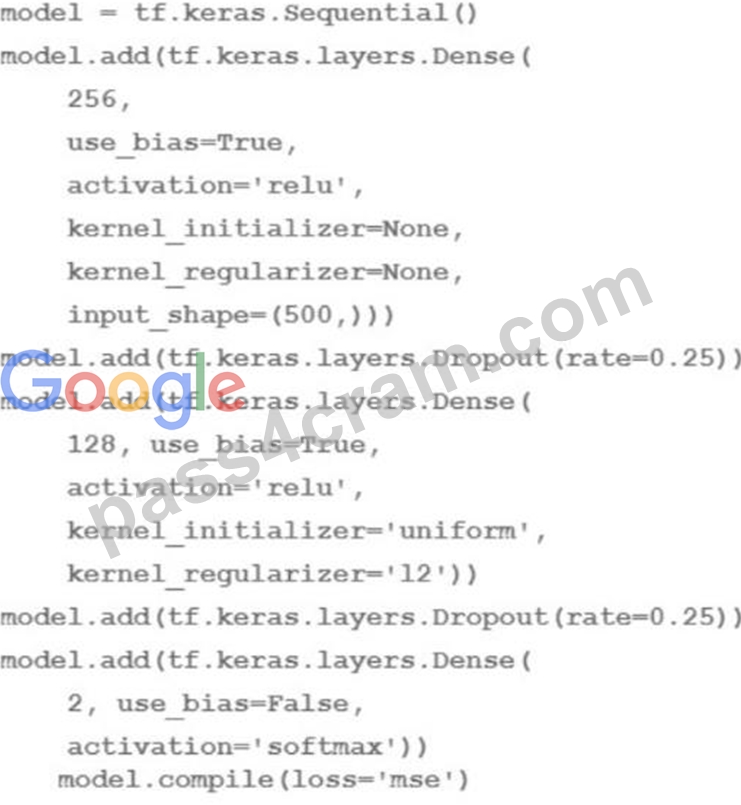
How many trainable weights does your model have? (The arithmetic below is correct.)
- A. 500*256+256*128+128*2 = 161024
- B. 501*256+257*128+2 = 161154
- C. 500*256*0 25+256*128*0 25+128*2 = 40448
- D. 501*256+257*128+128*2=161408
Answer: C
NEW QUESTION # 63
Your data science team needs to rapidly experiment with various features, model architectures, and hyperparameters. They need to track the accuracy metrics for various experiments and use an API to query the metrics over time. What should they use to track and report their experiments while minimizing manual effort?
- A. Use Al Platform Notebooks to execute the experiments. Collect the results in a shared Google Sheets file, and query the results using the Google Sheets API
- B. Use Al Platform Training to execute the experiments Write the accuracy metrics to Cloud Monitoring, and query the results using the Monitoring API.
- C. Use Kubeflow Pipelines to execute the experiments Export the metrics file, and query the results using the Kubeflow Pipelines API.
- D. Use Al Platform Training to execute the experiments Write the accuracy metrics to BigQuery, and query the results using the BigQueryAPI.
Answer: D
NEW QUESTION # 64
You are an ML engineer at a bank. You have developed a binary classification model using AutoML Tables to predict whether a customer will make loan payments on time. The output is used to approve or reject loan requests. One customer's loan request has been rejected by your model, and the bank's risks department is asking you to provide the reasons that contributed to the model's decision. What should you do?
- A. Use the feature importance percentages in the model evaluation page.
- B. Vary features independently to identify the threshold per feature that changes the classification.
- C. Use the correlation with target values in the data summary page.
- D. Use local feature importance from the predictions.
Answer: D
Explanation:
This would allow you to identify which features contributed the most to the model's decision, which would in turn help you to better explain why the model rejected the customer's loan request.
Varying features independently could also be a useful approach, as this would help to identify specific threshold values that change the classification. However, this strategy would be more time-consuming and would not provide as much insight into the inner-workings of the model compared to using local feature importance.
NEW QUESTION # 65
You are training a Resnet model on Al Platform using TPUs to visually categorize types of defects in automobile engines. You capture the training profile using the Cloud TPU profiler plugin and observe that it is highly input-bound. You want to reduce the bottleneck and speed up your model training process. Which modifications should you make to the tf .data dataset?
Choose 2 answers
- A. Use the interleave option for reading data
- B. Set the prefetch option equal to the training batch size
- C. Decrease the batch size argument in your transformation
- D. Reduce the value of the repeat parameter
- E. Increase the buffer size for the shuffle option.
Answer: A,C
NEW QUESTION # 66
You have a demand forecasting pipeline in production that uses Dataflow to preprocess raw data prior to model training and prediction. During preprocessing, you employ Z-score normalization on data stored in BigQuery and write it back to BigQuery. New training data is added every week. You want to make the process more efficient by minimizing computation time and manual intervention. What should you do?
- A. Normalize the data using Google Kubernetes Engine
- B. Translate the normalization algorithm into SQL for use with BigQuery
- C. Use the normalizer_fn argument in TensorFlow's Feature Column API
- D. Normalize the data with Apache Spark using the Dataproc connector for BigQuery
Answer: B
NEW QUESTION # 67
......
Pass Your Google Exam with Professional-Machine-Learning-Engineer Exam Dumps: https://www.pass4cram.com/Professional-Machine-Learning-Engineer_free-download.html
Professional-Machine-Learning-Engineer Dumps PDF New [2023] Ultimate Study Guide: https://drive.google.com/open?id=1Uv7yl1cORd905VJTcsm0Tjxs7j4NNmgC