


[Feb-2023] L4M7 Certification with Actual Questions from Pass4cram
Updated L4M7 Dumps PDF - L4M7 Real Valid Brain Dumps With 135 Questions!
CIPS L4M7 Exam Syllabus Topics:
| Topic | Details |
|---|---|
| Topic 1 |
|
| Topic 2 |
|
| Topic 3 |
|
| Topic 4 |
|
| Topic 5 |
|
| Topic 6 |
|
NEW QUESTION 18
Objective forecasting techniques must be based on which of the following?
1. Opinions
2. Figures
3. Facts
4. Jugdement
- A. 2 and 3 only
- B. 1 and 4 only
- C. 1 and 2 only
- D. 3 and 4 only
Answer: A
Explanation:
Subjective forecasting uses qualitative methods (surveys, opinions) which relay on perception and opinion. Objective forecasting uses quantitative methods (facts and figures). Both methods have to make assumption about how closely (or not) the future will resemble the present and the past. Forecasting is never exact.
Reference:
LO 2, AC 2.3
NEW QUESTION 19
Which of the following can replace pallets as bases for unit loads but they require push pull acces-sories to retrieve or discharge unit load?
- A. Shrink wraps
- B. Post pallets
- C. Slip sheets
- D. Skids
Answer: C
Explanation:
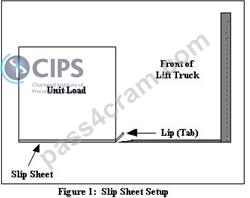
The system of slip sheet load handling involves the use of a thin sheet of material, the slip sheet, as a base on which items are assembled as a unit load for handling, storage, and transport. The slip sheet is used in conjunction with a pallet, if desired, at certain stages in the distribution cycle. If all lift trucks in the cycle are equipped with the proper attachment, an appropriate slip sheet is the only material handling base required. Slip sheet requires special push pull accessories and usually use thin and wide forks.
Skids are generally described as single-deck pallets and do not have bottom flatted layer which makes them less bulky and cheaper than conventional pallets but also less universal in their use.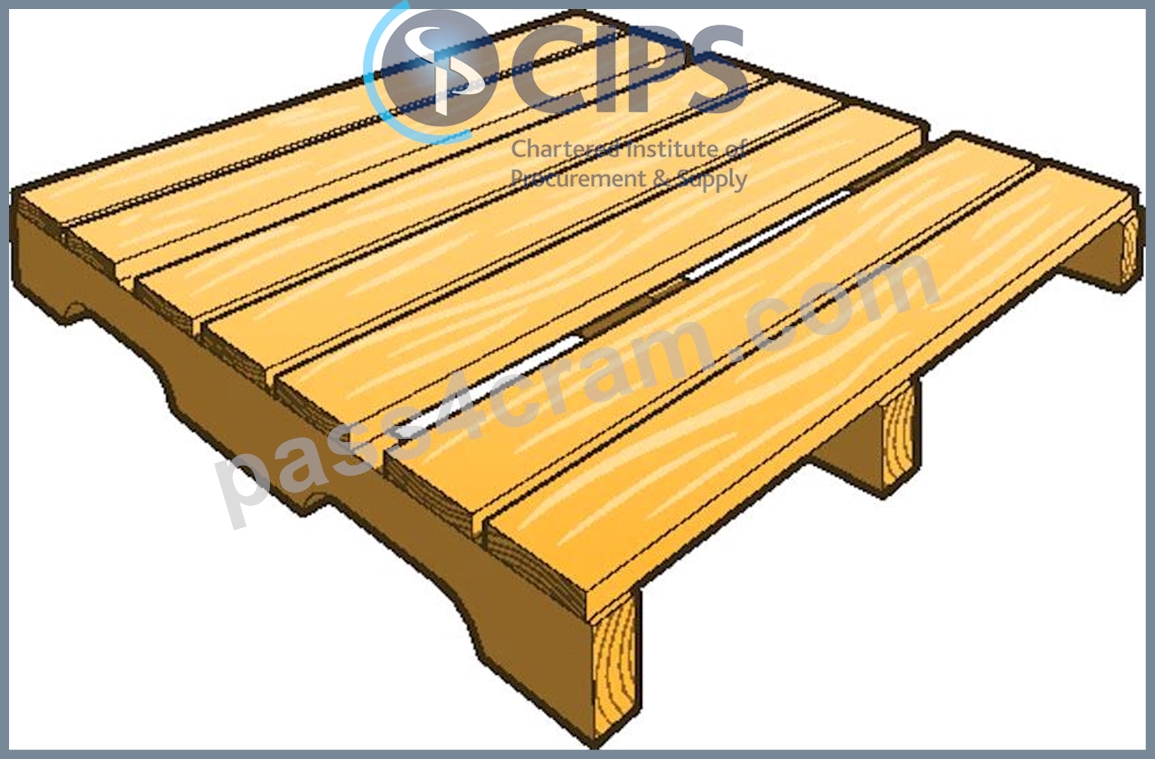
Shrink wrap, also referred to as shrink film or shrink wrap, is a versatile polymer material used for the packaging of finished goods. Heat is applied to the film - by either a conveyor heat tunnel or an electric or gas heat gun - which catalyzes the film to shrink tightly around the item placed within. This process results in a clear, durable barrier of protection around the product.
Post pallets have a simple metal structure with four uprights and substantial feat to take the load. These may be free standing, but many are designed for the feet to interlock with the posts of another post pallet so that the stack can be created.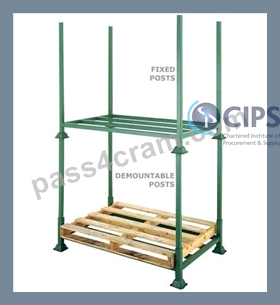
Reference:
LO 1, AC 1.3
NEW QUESTION 20
Which of the following is the Japanese word for 'billboard' or 'signboard'?
- A. Muda
- B. Kanban
- C. Kaizen
- D. Poka-Yoke
Answer: B
Explanation:
Kanban (看板) (signboard or billboard in Japanese) is a scheduling system for lean manufacturing and just-in-time manufacturing (JIT).
Poka-yoke (ポカヨケ, [poka yoke]) is a Japanese term that means "mistake-proofing" or "inadvertent error prevention". A poka-yoke is any mechanism in any process that helps an equipment operator avoid (yokeru) mistakes (poka). Its purpose is to eliminate product defects by preventing, correcting, or drawing attention to human errors as they occur.
Kaizen is a concept referring to business activities that continuously improve all functions and involve all employees from the CEO to the assembly line workers. Kaizen (改善) is the Sino-Japanese word for "improvement". Kaizen also applies to processes, such as purchasing and logis-tics, that cross organizational boundaries into the supply chain.
Muda (無駄, on'yomi reading) is a Japanese word meaning "futility; uselessness; wastefulness", and is a key concept in lean process thinking, like the Toyota Production System (TPS) as one of the three types of deviation from optimal allocation of resources (the others being mura and muri). Waste reduction is an effective way to increase profitability.
Reference:
LO 2, AC 2.3
NEW QUESTION 21
What is the different between gross material requirements plan (gross MRP) and a net material requirements plan (net MRP)?
- A. The gross MRP includes consideration of available inventory, whereas the net MRP does not
- B. The gross MRP is mostly paper-based, but the net MRP must be computerised
- C. The gross requirement doesn't take taxes into account, whereas the net requirement includes the tax considerations
- D. The net MRP includes the amount of inventory on hand, whereas the gross MRP does not
Answer: A
Explanation:
Material requirement planning (MRP) is a production planning and material (inventory) control system used in manufacturing. Objectives of MRP are to ensure materials are available for production while minimising inventory and to plan production and procurement activities.
MRP software combines the master production schedule, the bill of materials and the inventory information to work out the net requirements (net MRP) of what to purchase or produce and when.
These net requirements are worked out using the following equation:
Net requirements = Total requirements - Available inventory
Where:
Total requirement = Gross requirements (gross MRP)
Available inventory = Inventory on hand + Units on order
In the other words, Gross MRP = Net MRP + Available inventory, so the answer should be "The gross MRP includes consideration of available inventory, whereas the net MRP does not" LO 2, AC 2.3
NEW QUESTION 22
International Standard Book Number (ISBN) is a unique international identification system for each product form or edition of a monographic publication published or produced by a specific publisher. ISBN is an example of...?
- A. Own product code system
- B. Industry standard code
- C. Harmonized system
- D. Check digit
Answer: B
Explanation:
The International Standard Book Number (ISBN) is a numeric commercial book identifier which is intended to be unique. Publishers purchase ISBNs from an affiliate of the International ISBN Agency. ISBN is standardised by ISO 2108:2017. ISBN is an example of industry standard code as it applies to commercial books around the world.
Check digits are additional numbers or characters added to codes that a computer uses to verify the number is valid. The intention is to reduce the likelihood of miskeying an item and hitting an alternative live item. More often, a system is devised which a computer can calculate using combination of numbers.
Own product code system: an organisation will use its own product code system. This has the ad-vantage that the organisation can construct a code that is effective and fits with its software and variety of items covered.
The Harmonized Commodity Description and Coding System, also known as the Harmonized System (HS) of tariff nomenclature is an internationally standardized system of names and numbers to classify traded products. It came into effect in 1988 and has since been developed and maintained by the World Customs Organization (WCO) (formerly the Customs Co-operation Council), an independent intergovernmental organization based in Brussels, Belgium, with over 200 member countries.
Reference:
LO 1, AC 1.2
NEW QUESTION 23
Which of the following are most likely to be direct benefits of applying RFID technology? Select TWO that apply
- A. Being able to work in harsh conditions without any supports
- B. Being able to work in 1km range or above
- C. Identifying product defects
- D. Multiple items tracking
- E. Large information capacity
Answer: D,E
Explanation:
RFID tags are the small devices that can be embedded in labels or attached to tags which work with radio transmitters and/or receivers to identify themselves.
RFID tags can be used to do the following:
- Track individual items
- Track boxes of products, cages of products and pallets
- Track containers with multiple loads
- Locate equipment within a building
- Trigger alarms should equipment or stock be removed without authorisation.
RFID devices have a very small integrated circuit incorporating a small memory capability - many are smaller than 2mm square and 2mm thick. Despite its size, many can hold 2000 characters of data.
RFID operating rage depends on the radio frequency used, receiver capability and the environment. Some tags are only readable from under 1m, others can have a 100m range.
RFID tags and labels are very specific to the type of material and size of your assets. For example, metal will deactivate the RFID antenna and the tag will not transmit at all. Using RFID on metal requires a special type of tag with an RFID block to prevent interference with the antenna. Liquid products can also affect the reliability of the RFID signal. To use RFID tags in specific environ-ments, some technologies are needed to support them.
Reference:
LO 1, AC 1.2
NEW QUESTION 24
A hospital is purchasing a new software product that will advise nurses when to give medications to hospitalised patients. This is a mobile application that will be used on tablets carried by the nurses. The software is being developed and tested by a company that specialises in mobile medical applications. This software will interface with existing hospital software that orders the medications from the pharmacy. Which acceptance test activity will be required to check whether the new software integrates well with current IT system?
- A. Stress testing
- B. Health and safety testing
- C. Compatibility testing
- D. Dry running
Answer: C
Explanation:
In the scenario, one of the requirements for the new software is that the new one will interface with current system. Compatibility testing would be the most appropriate test here.
There are also other acceptance tests that are mentioned in L4M7 study guide:
- Health and safety test aims at establishing new health and safety routines, providing guidance notices and documentation and ensuring designed-in safety in operation.
- Stress testing (sometimes called torture testing) is a form of deliberately intense or thorough testing used to determine the stability of a given system, critical infrastructure or entity. It involves testing beyond normal operational capacity, often to a breaking point, in order to observe the results.
- A dry run (or a practice run) is a testing process where the effects of a possible failure are inten-tionally mitigated. For example, an aerospace company may conduct a "dry run" test of a jet's new pilot ejection seat while the jet is parked on the ground, rather than while it is in flight.
The usage of "dry run" in acceptance procedures (for example in the so-called FAT = factory ac-ceptance testing) is meant as following: the factory - which is a subcontractor - must perform a complete test of the system it has to deliver before the actual acceptance by customer.
Reference:
LO 3, AC 3.1
NEW QUESTION 25
Which of the following best describes the relationship between a service level and safety stock?
- A. When safety stock is zero the service level always equals zero.
- B. A safety stock is not always required to achieve a required service level
- C. A service level increases in proportion to an increase in safety stock
- D. A service level decreases in proportion to a decrease in safety stock
Answer: B
Explanation:
Holding extra stocks will always improve customer service levels, or at least reduce the risk of them falling. This implies that if an organisation aims at higher service levels, they should have larger safety stock. However, increasing safety stock is not the only solution to improve service level. The widespread adoption of just-in-time (JIT) techniques particularly in the automotive industry has greatly reduced costs with increased service levels as well as the additional benefit of increased problem visibility.
The correct answer should be 'A safety stock is not always required to achieve a required service level'.
Reference:
LO 2, AC 2.2
NEW QUESTION 26
A major investment bank is planning to purchase a complex banking system that will interface with multiple applications at varying times of the day. Before deploying the system, there are various levels of testing that must be performed through joint testing between the in-house team and off-shore testing consultants. The testing will be performed in a resource-constrained shared environment and managed by the on-shore development team. The costs for testing are generally classified as...?
- A. Purchase prices
- B. Acquisition costs
- C. Insurance
- D. Maintenance costs
Answer: B
Explanation:
In the scenario, the buying organisation (investment bank) must conduct various types of testing before the deployment of the software system. These tests can be functional testing, factory ac-ceptance testing and/or user acceptance testing. The costs for all these types of testing are classified as acquisition costs with regards of total cost of ownership.
Reference:
LO 3, AC 3.1
NEW QUESTION 27
In a manufacturing facility, which types of inventory have the lowest value?
1. Finished goods
2. Secondary components
3. Work in progress
4. Raw materials
- A. 1 and 3 only
- B. 1 and 2 only
- C. 3 and 4 only
- D. 2 and 4 only
Answer: D
Explanation:
Raw materials are basic input materials - they are only processed limitedly or have not been pro-cessed at all. Their values are equal to acquisition cost and are the lowest value of stock held.
Secondary components are the products that are combined with others to produce the finished goods. They are acquired in the processed state. Their value is higher than raw materials, but still at acquisition cost.
Work in progress is the stock part-way through manufacture that has not been finished. It is typically not completed yet, so it doesn't have full value. But the costs of processing already carried out makes it more valuable than materials and components.
Finished goods are completed and ready to be used or sold. Finished goods are the most expensive and need to be stored in good conditions.
Reference:
LO 2, AC 2.1
NEW QUESTION 28
Resevoir Inc runs several oil refineries across the country. These refineries require heavy invest-ment, particularly in maintenance, repair and operating (MRO) inventory. But the inventory turno-ver rate of these MRO items are low, while some items have expired date, which increases the risks of obsolescence. Which of the following methods can address the issues of these MRO items?
- A. Vendor-owned stock
- B. Just in case
- C. Forrester effect
- D. Larger safety stock
Answer: A
Explanation:
Where stock turn (inventory turnover) is low and there are potential risks of redundancy or obsolescence, the buying organisation may adopt vendor owned stock. In this system, a supplier (vendor) maintains a stock of items ready to be used at the point of customer consumption. The supplier owns the stock until it is used by the purchaser; only then is the purchaser invoiced for it.
Just in case and larger safety stock would significantly increase the stock level, which may cause redundancy or obsolescence.
Forrester effect (or Bullwhip effect) is a distribution channel phenomenon in which forecasts yield supply chain inefficiencies. It refers to increasing swings in inventory in response to shifts in customer demand as one moves further up the supply chain.
Reference:
LO 2, AC 2.2
NEW QUESTION 29
In ABC analysis, category C is also known as...?
- A. Capital expense
- B. Indirect spend
- C. Long tail spend
- D. Direct spend
Answer: C
Explanation:
Tail Spend is derived from ABC Analysis, Class A high value suppliers, Tail Spend is formed from class B & C suppliers, equates to 20% of the total spend, B is Mid Tail and C is Long tail. Effective Spend Analysis and tail spend management, ensures that procurement can focus on creating an optimum and efficient sourcing strategy.
Procurement Spend Analysis
Procurement organisations effectively identify and manage suppliers using a sourcing strategy. Tail suppliers normally have low strategic value and makes the category management, very difficult . Spend Analysis and Category Management are very closely aligned, Spend Analysis including ABC, provides the category manager, with spend visibility.
Spend Analysis and procurement metrics are used to create category plans, build supplier relation-ships, to maintain service levels and deliver the best possible price and quality for goods and ser-vices bought. The acquisition of Spend data and subsequent Spend Analysis, provides Category Managers access to a well-structured procurement process, Reference:
LO 2, AC 2.1
NEW QUESTION 30
Which of the following is the most suitable container of fasteners (screws, nails, nuts and bolts,...)?
- A. Stock cage
- B. Tote box
- C. Bar rack
- D. Pallet
Answer: B
Explanation:
Tote box is the reusable storage box. These can be open or have lids or flaps to close them and come in a large variety of sizes and weight loadings.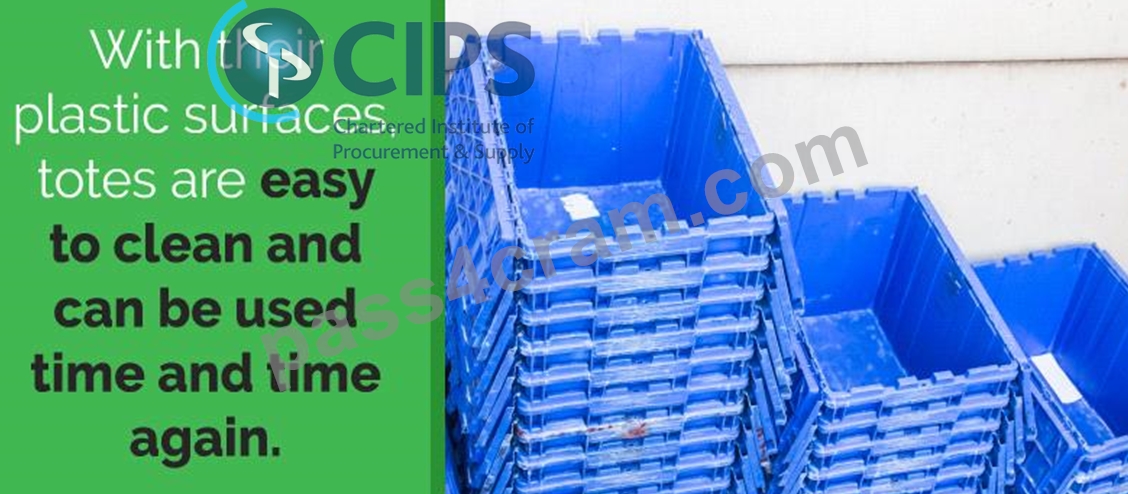
A tote is ideal for holding and hauling items such as: tools, fasteners, bark dust, dry cement, cords, wires, smaller boxes,...
Pallets are the platform structures designed to support a load and be lifted using the forks (typically seen on forklift trucks and other equipment). These are in a variety of standard sizes and can be made of many materials including plastics, resin, board or timber. Pallets are not containers, but support platforms.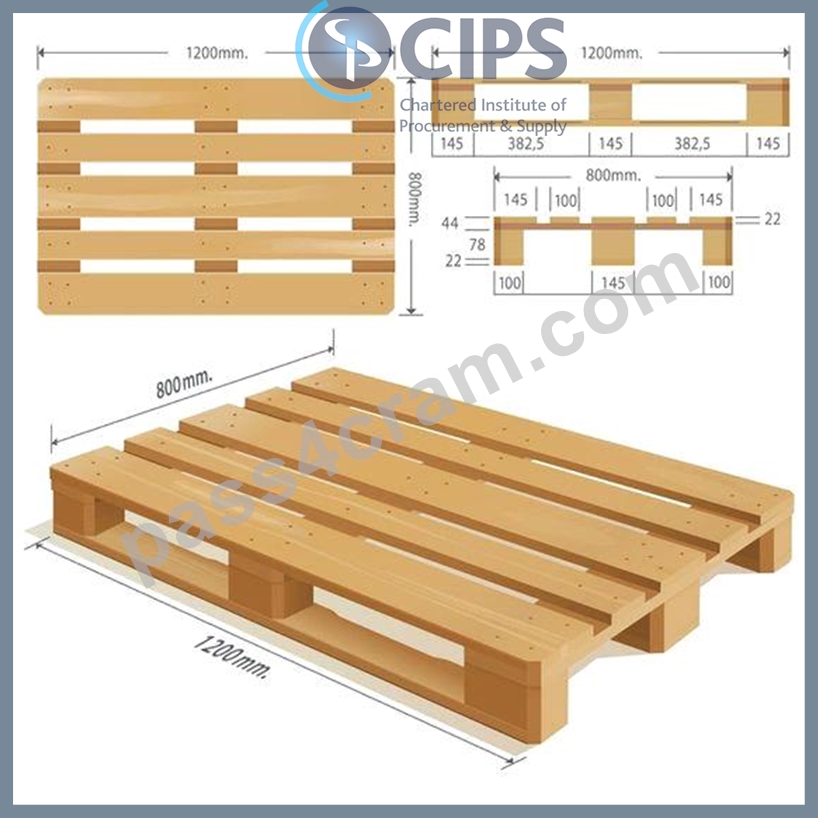
Bar racks are designed to store bars and pipes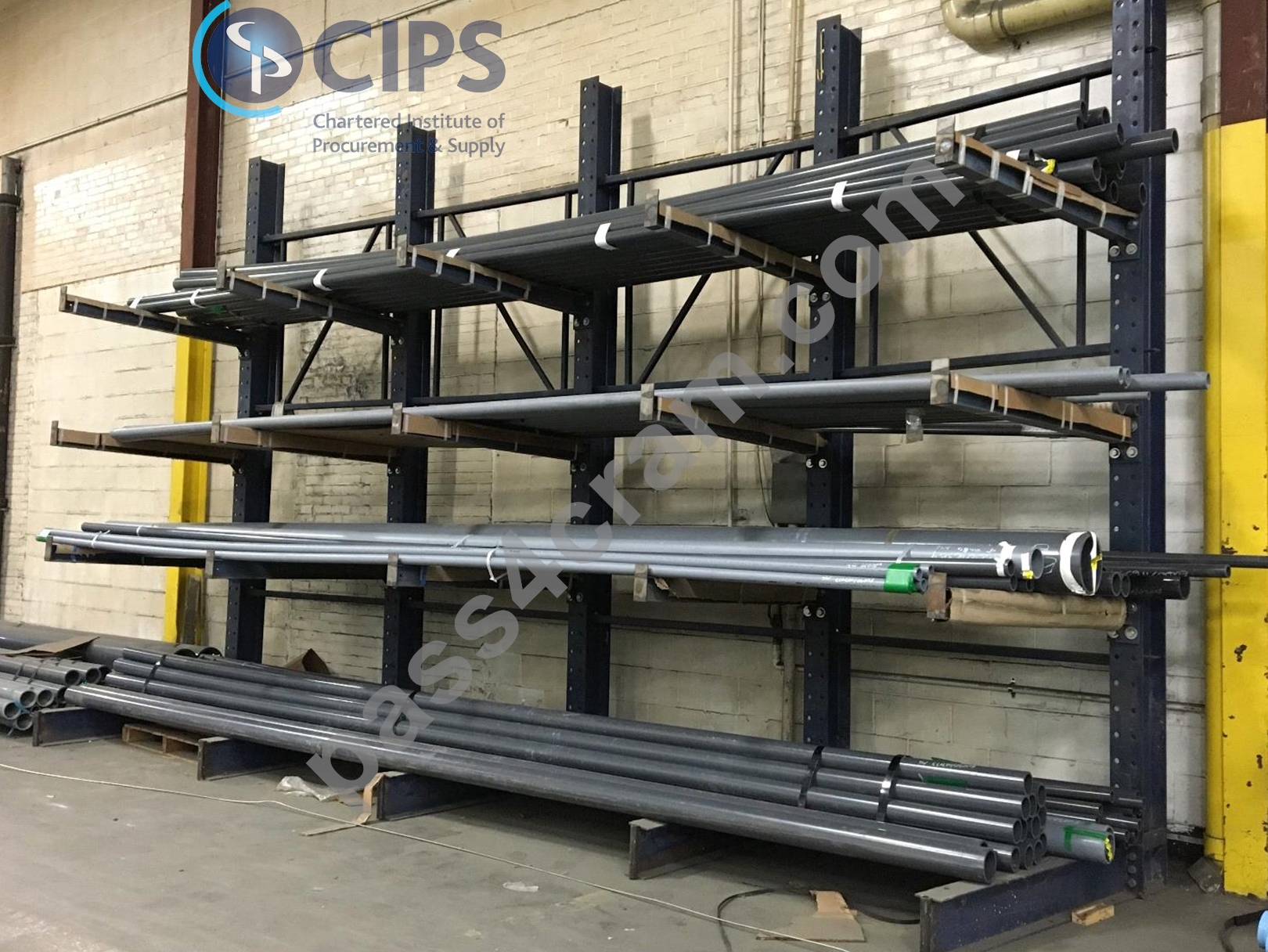
Stock cages are available in many sizes and can hold single items or groups of items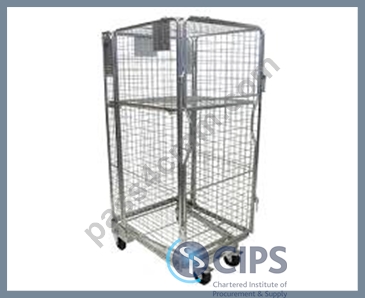
Reference:
LO 1, AC 1.1
NEW QUESTION 31
Practice of unloading goods from inbound delivery vehicles and loading them directly onto out-bound vehicles is known as ...?
- A. Decommissioning
- B. Cross-docking
- C. Tracing and tracking
- D. Automation
Answer: B
Explanation:
Cross-docking is the practice of unloading goods from inbound delivery vehicles and loading them directly onto outbound vehicles. By eliminating or minimizing warehouse storage costs, space requirements and inventory handling, cross-docking can streamline supply chains and help them move goods to market faster and more efficiently.
Cross-docking usually takes place in a dedicated docking terminal in a warehouse, where inbound goods are first received at a dock and sorted according to their final destinations. They are then moved to the other side of the dock via forklift, conveyor belt or other equipment and loaded on outbound vehicles.
Cross-docking works best with products that need to be transported quickly, such as food, that have already been sorted and labeled for customers, do not need quality inspections or have steady demand.
Reference:
- CIPS study guide page 16
- Cross-docking
LO 1, AC 1.1
NEW QUESTION 32
Which of the following is the minimum aisle width for using standard counterbalanced forklifts?
- A. 10.5 ft - 13.1 ft
- B. 5.6 ft - 5.9 ft
- C. 6.9 ft - 7.2 ft
- D. 4.9 ft - 5.2 ft
Answer: A
Explanation:
Minimum open aisle width for standard counterbalance forklift is 10.5-13.1 ft. You can look at the minimum aisle width for different equipment here, or calculate yourself with an instruction here.
LO 1, AC 1.3
NEW QUESTION 33
Which of the following is NOT an improvement available in ERP II in compare with ERP?
- A. ERP II crosses all sectors and segments of business, including service, government and asset-based industries
- B. ERP II systems are closed and silo-working
- C. ERP II enables the organisation to collaborate with trading partners across the supply chain
- D. ERP II offers better integration with other proprietary software
Answer: B
Explanation:
The main improvements from ERP to ERP II are the following:
- ERP II is web enabled as compared to Conventional ERP Which is not.
- ERP is restricted to provide selected exhaustive or rigorous or wide-spread coverage in its mod-ules. But as compared to ERP, ERP II provides the true and accurate blend of the macro and the micro and affords customers with curative actions/measures after identifying the slip-up/error or fault;
- ERP was embattled more headed for manufacturing or industrialization and the dilemma or difficulty is conquer in ERP II by endowing clarification for all kind of industries and sectors.
- ERP is not in the position or could not possibly integrate/incorporate diverse functions from di-verse departments/divisions but ERP II could possibly do so as well as from different industries as compared to conventional ERP.
- For WEB and WAP connectivity ERP II grip CRM and SCM Functionalities.
- ERP II be obliged the function and purpose to an external/outdoor one and smooth the progress of better networks than remaining as internal/interior application.
Reference:
- Next Generation Enterprise Resource Planning: ERP II
- CIPS study guide page 119-122
LO 2, AC 2.3
NEW QUESTION 34
Which of the following are most likely the benefits of using unit loads? Select TWO that apply.
Increase transport time of each item
- A. Minimise space utilisation
- B. Safer handling
- C. Reduce handling cost of one unit
- D. Unit loads must be placed on pallets
Answer: B,C
Explanation:
The concept of a unit load is to create a stable and secure, easy-to-move group of stock that is fast to load and unload from vehicles.
The advantages of unit load concepts are as the following:
* More items can be handled at the same time, thereby reducing the number of trips required and, potentially, reducing handling costs, loading and unloading times, and product damage.
* Enables the use of standardized material handling equipment.
Reference:
LO 1, AC 1.3
NEW QUESTION 35
Which type of codes can a barcode laser scanner (linear scanner) read?
- A. Numerical code
- B. Aztec code
- C. 1D barcode
- D. QR code
Answer: C
Explanation:
One-dimensional (or 1D) barcodes systematically represent data by varying the widths and spac-ings of parallel lines. These include some of the most traditional and well-recognized barcode types, such as the UPC and EAN codes. 1D barcodes are also commonly referred to as linear barcodes.
Two-dimensional (2D) barcodes look like squares or rectangles that contain many small, individual dots. QR codes, Data matrix and Aztec codes are examples of 2D barcodes Numerical code contains all numbers, no letters There are two different scan engine types (laser scanner versus imager) for interpreting the infor-mation provided in the barcode. Many companies producing the technology capable of reading the barcode data uses the term "scanning" regardless of the type of scan engine used. For the purposes of these FAQs, we are trying to draw a clearer distinction for you.
Linear (1D) codes can be scanned with a traditional laser scanner. A laser scan engine uses a laser and mirror to create the bar that scans the information. 1D barcode scanners will only interpret the linear barcode scanning technology. 1D barcode scanners are typically less expensive since the type of encryptions they can decode is limited.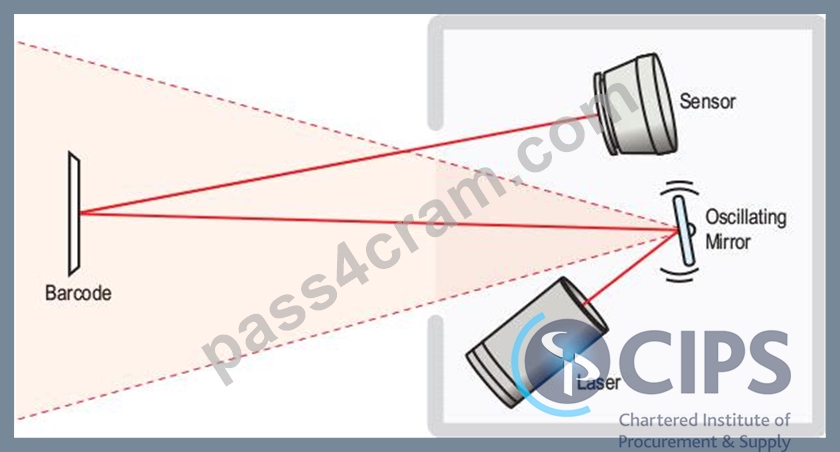
LO 1, AC 1.2
NEW QUESTION 36
......
Pass Your L4M7 Exam Easily With 100% Exam Passing Guarantee: https://www.pass4cram.com/L4M7_free-download.html
100% Free L4M7 Exam Dumps Use Real Level 4 Diploma in Procurement and Supply Dumps: https://drive.google.com/open?id=1u6EobN7jHJD8jrKxIGzUkgimb-sFOOFR