


Provide Valid AZ-305 Dumps To Help You Prepare For Designing Microsoft Azure Infrastructure Solutions Exam Mar 04, 2026
Microsoft AZ-305 Dumps Questions [2026] Pass for AZ-305 Exam
Who is this Microsoft AZ-305 exam for?
This Microsoft AZ-305 exam is designed for IT professionals who are currently working on the Azure platform. These professionals can be system administrators, network administrators, developers, architects, and consultants. They can also be working as a project manager, solution architect, system integrator, and enterprise architect. AZ-305 exam dumps are suitable for everyone who is interested in gaining this Microsoft Azure Infrastructure Solutions Certification. You can use the braindumps to get prepared for the Microsoft AZ-305 Certification Exam. The customer support team can also use this exam to verify their technical skills. Network architecture professionals can also take this exam. Messaging-driven business applications can use this exam to test their technical knowledge.
Microsoft AZ-305 is a certification exam that focuses on designing Microsoft Azure infrastructure solutions. AZ-305 exam is intended for professionals who want to validate their skills in designing Azure-based solutions that meet business requirements. Designing Microsoft Azure Infrastructure Solutions certification is aimed at individuals who have a good understanding of Azure services, including compute, storage, network, and security, and who are interested in designing solutions for Azure-based workloads.
Microsoft AZ-305 Exam is a comprehensive certification exam designed for professionals who want to pursue a career in designing Azure infrastructure solutions. AZ-305 exam focuses on testing the knowledge and skills required for designing, implementing, and monitoring Azure solutions.
NEW QUESTION # 112
You have an on-premises network and an Azure subscription. The on-premises network has several branch offices.
A branch office in Toronto contains a virtual machine named VM1 that is configured as a file server. Users access the shared files on VM1 from all the offices.
You need to recommend a solution to ensure that the users can access the shares files as quickly as possible if the Toronto branch office is inaccessible.
What should you include in the recommendation?
- A. Azure blob containers and Azure File Sync
- B. an Azure file share and Azure File Sync
- C. a Recovery Services vault and Azure Backup
- D. a Recovery Services vault and Windows Server Backup
Answer: B
Explanation:
Explanation
Use Azure File Sync to centralize your organization's file shares in Azure Files, while keeping the flexibility, performance, and compatibility of an on-premises file server. Azure File Sync transforms Windows Server into a quick cache of your Azure file share.
You need an Azure file share in the same region that you want to deploy Azure File Sync.
Reference:
https://docs.microsoft.com/en-us/azure/storage/files/storage-sync-files-deployment-guide
NEW QUESTION # 113
You have an application that is used by 6,000 users to validate their vacation requests. The application manages its own credential Users must enter a username and password to access the application. The application does NOT support identity providers.
You plan to upgrade the application to use single sign-on (SSO) authentication by using an Azure Active Directory (Azure AD) application registration.
Which SSO method should you use?
- A. OpenID Connect
- B. SAML
- C. header-based
- D. password-based
Answer: B
NEW QUESTION # 114
You have an on-premises named App 1.
Customers App1 to manage digital images.
You plan to migrate App1 to Azure.
You need to recommend a data storage solution for Appl. The solution must meet the following image storage requirements:
Encrypt images at rest.
Allow files up to 50M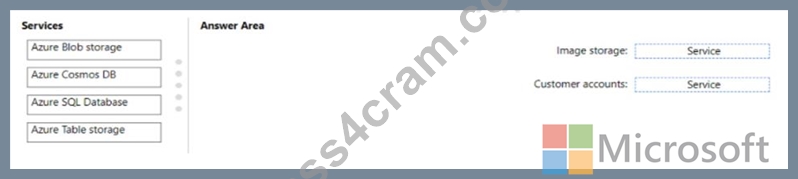
Answer:
Explanation: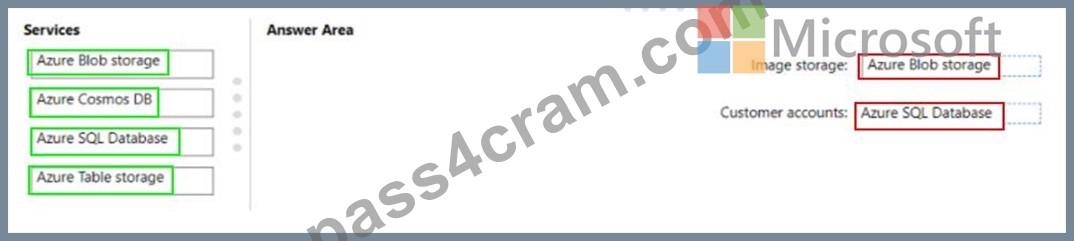
NEW QUESTION # 115
You have an Azure subscription.
You plan to deploy five storage accounts that will store block blobs and five storage accounts that will host file shares. The file shares will be accessed by using the SMB protocol.
You need to recommend an access authorization solution for the storage accounts. The solution must meet the following requirements:
* Maximize security.
* Prevent the use of shared keys.
* Whenever possible, support time-limited access.
What should you include in the solution? To answer, select the appropriate options in the answer area.
NOTE: Each correct selection is worth one point.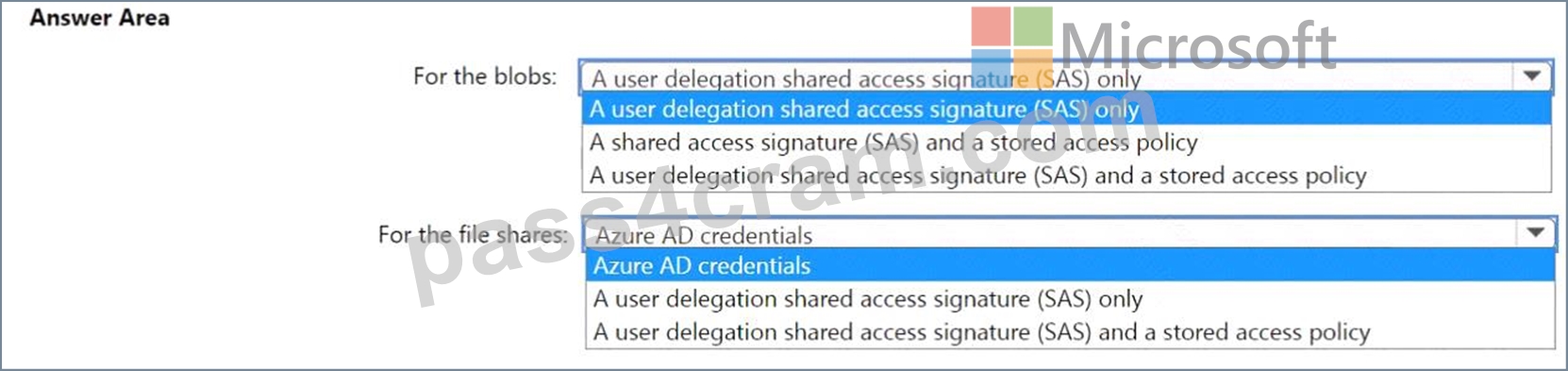
Answer:
Explanation: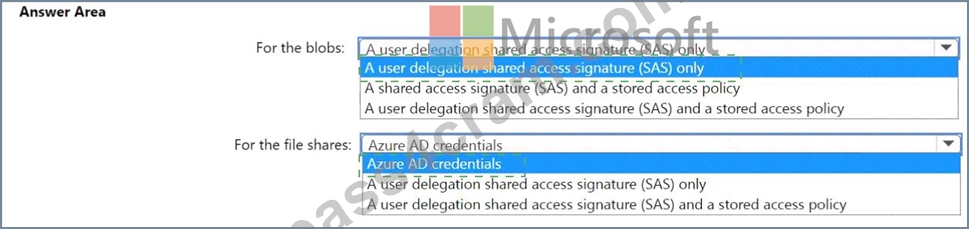
Explanation
NEW QUESTION # 116
The application will host video files that range from 50 MB to 12 GB. The application will use certificate-based authentication and will be available to users on the internet.
You need to recommend a storage option for the video files. The solution must provide the fastest read performance and must minimize storage costs.
What should you recommend?
- A. Azure Files
- B. Azure SQL Database
- C. Azure Blob Storage
- D. Azure Data Lake Storage Gen2
Answer: C
Explanation:
Blob Storage: Stores large amounts of unstructured data, such as text or binary data, that can be accessed from anywhere in the world via HTTP or HTTPS. You can use Blob storage to expose data publicly to the world, or to store application data privately.
Max file in Blob Storage. 4.77 TB.
Reference:
https://docs.microsoft.com/en-us/azure/architecture/solution-ideas/articles/digital-media-video
NEW QUESTION # 117
You have multiple on-premises networks.
You have multiple Azure subscriptions. Each subscription contains a virtual network that is assigned an IP address space of 172.16.0.0/16. Each virtual network is connected to the on- premises networks by using ExpressRoute.
You plan to deploy a container orchestration solution that will use multiple Azure Kubernetes Service (AKS) clusters. The clusters will be deployed to the existing virtual networks.
You need to recommend a network configuration for the AKS clusters. The solution must meet the following requirements:
- Minimize the number of IP addresses required on each virtual network.
- Support outbound connectivity to on-premises datacenters.
- Support Windows node pools.
Which AKS network model should you recommend?
- A. kubenet
- B. Azure CNI Overlay
- C. Azure CNI Powered by Cilium
- D. Azure CNI
Answer: D
Explanation:
Azure CNI is a network model designed for advanced networking. It provides full virtual network connectivity for pods, allowing for pod-to-pod and pod-to-VM connectivity. It's ideal for scenarios where advanced AKS features, such as virtual nodes, are required. It's suitable for scenarios where sufficient IP address space is available, and external resources need to reach pods directly. AKS network policies are also supported with Azure CNI.
Reference:
https://learn.microsoft.com/en-us/azure/cloud-adoption-framework/scenarios/app- platform/aks/network-topology-and-connectivity
NEW QUESTION # 118
You have an Azure subscription.
You need to deploy a relational database. The solution must meet the following requirements:
* Support multiple read-only replicas.
* Automatically load balance read-only requests across all the read-only replicas.
* Minimize administrative effort
What should you use? To answer, select the appropriate options in the answer area.
NOTE: Each correct selection is worth one point.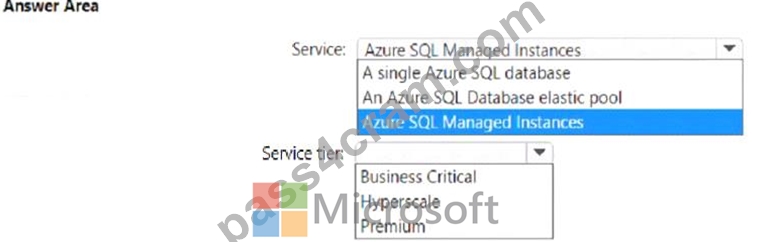
Answer:
Explanation: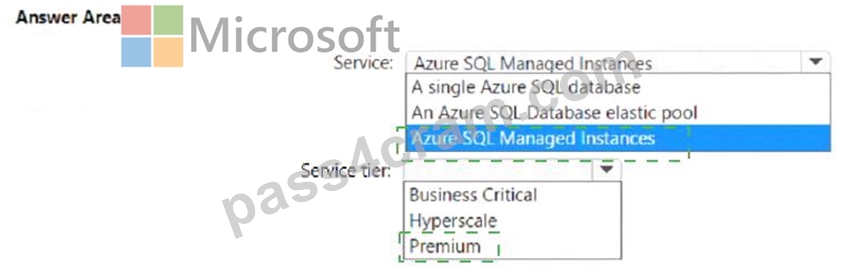
Explanation:
NEW QUESTION # 119
You plan to migrate App1 to Azure.
You need to recommend a storage solution for App1 that meets the security and compliance requirements.
Which type of storage should you recommend, and how should you recommend configuring the storage? To answer, select the appropriate options in the answer area.
NOTE:Each correct selection is worth one point.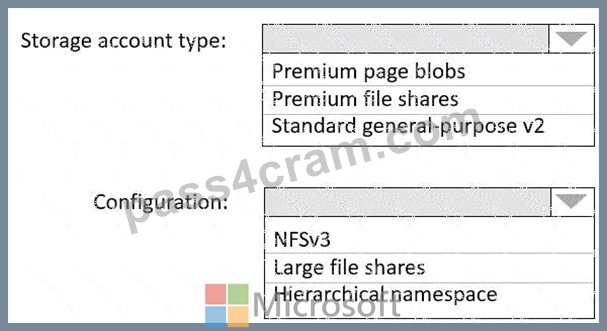
Answer:
Explanation: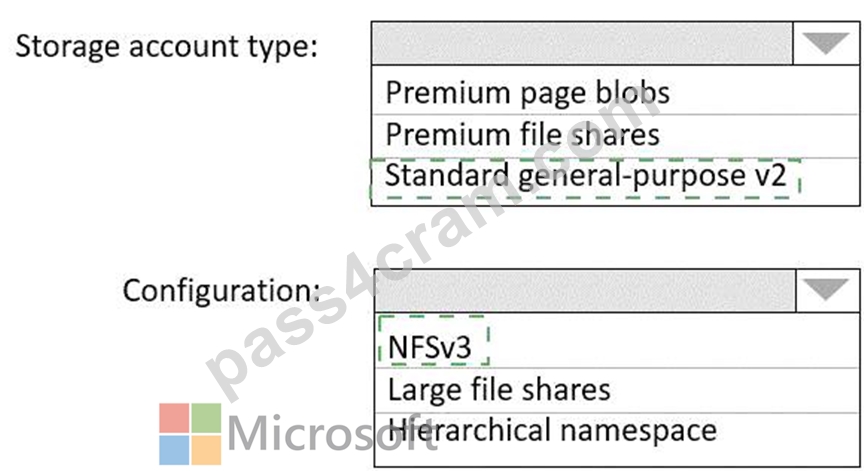
Explanation
Text, table Description automatically generated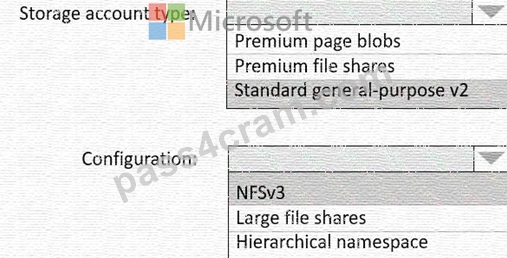
Box 1: Standard general-purpose v2
Standard general-purpose v2 supports Blob Storage.
Azure Storage provides data protection for Blob Storage and Azure Data Lake Storage Gen2.
Scenario:
Litware identifies the following security and compliance requirements:
Once App1 is migrated to Azure, you must ensure that new data can be written to the app, and the modification of new and existing data is prevented for a period of three years.
On-premises users and services must be able to access the Azure Storage account that will host the data in App1.
Access to the public endpoint of the Azure Storage account that will host the App1 data must be prevented.
All Azure SQL databases in the production environment must have Transparent Data Encryption (TDE) enabled.
App1 must NOT share physical hardware with other workloads.
Box 2: NFSv3
Scenario: Plan: Migrate App1 to Azure virtual machines.
Blob storage now supports the Network File System (NFS) 3.0 protocol. This support provides Linux file system compatibility at object storage scale and prices and enables Linux clients to mount a container in Blob storage from an Azure Virtual Machine (VM) or a computer on-premises.
Reference:
https://docs.microsoft.com/en-us/azure/storage/blobs/data-protection-overview
NEW QUESTION # 120
Case Study 2 - Fabrikam, Inc
Overview
Fabrikam, Inc. is an engineering company that has offices throughout Europe. The company has a main office in London and three branch offices in Amsterdam, Berlin, and Rome.
Existing Environment: Active Directory Environment
The network contains two Active Directory forests named corp.fabrikam.com and rd.fabrikam.com. There are no trust relationships between the forests.
Corp.fabrikam.com is a production forest that contains identities used for internal user and computer authentication.
Rd.fabrikam.com is used by the research and development (R&D) department only. The R&D department is restricted to using on-premises resources only.
Existing Environment: Network Infrastructure
Each office contains at least one domain controller from the corp.fabrikam.com domain. The main office contains all the domain controllers for the rd.fabrikam.com forest.
All the offices have a high-speed connection to the internet.
An existing application named WebApp1 is hosted in the data center of the London office.
WebApp1 is used by customers to place and track orders. WebApp1 has a web tier that uses Microsoft Internet information Services (IIS) and a database tier that runs Microsoft SQL Server
2016. The web tier and the database tier are deployed to virtual machines that run on Hyper-V.
The IT department currently uses a separate Hyper-V environment to test updates to WebApp1.
Fabrikam purchases all Microsoft licenses through a Microsoft Enterprise Agreement that includes Software Assurance.
Existing Environment: Problem Statements
The use of WebApp1 is unpredictable. At peak times, users often report delays. At other times, many resources for WebApp1 are underutilized.
Requirements: Planned Changes
Fabrikam plans to move most of its production workloads to Azure during the next few years, including virtual machines that rely on Active Directory for authentication.
As one of its first projects, the company plans to establish a hybrid identity model, facilitating an upcoming Microsoft 365 deployment.
All R&D operations will remain on-premises.
Fabrikam plans to migrate the production and test instances of WebApp1 to Azure.
Requirements: Technical Requirements
Fabrikam identifies the following technical requirements:
* Website content must be easily updated from a single point.
* User input must be minimized when provisioning new web app instances.
* Whenever possible, existing on-premises licenses must be used to reduce cost.
* Users must always authenticate by using their corp.fabrikam.com UPN identity.
* Any new deployments to Azure must be redundant in case an Azure region fails.
* Whenever possible, solutions must be deployed to Azure by using the Standard pricing tier of Azure App Service.
* An email distribution group named IT Support must be notified of any issues relating to the directory synchronization services.
* In the event that a link fails between Azure and the on-premises network, ensure that the virtual machines hosted in Azure can authenticate to Active Directory.
* Directory synchronization between Azure Active Directory (Azure AD) and corp.fabrikam.com must not be affected by a link failure between Azure and the on-premises network.
Requirements: Database Requirements
Fabrikam identifies the following database requirements:
* Database metrics for the production instance of WebApp1 must be available for analysis so that database administrators can optimize the performance settings.
* To avoid disrupting customer access, database downtime must be minimized when databases are migrated.
* Database backups must be retained for a minimum of seven years to meet compliance requirements.
Requirements: Security Requirements
Fabrikam identifies the following security requirements:
* Company information including policies, templates, and data must be inaccessible to anyone outside the company.
* Users on the on-premises network must be able to authenticate to corp.fabrikam.com if an internet link fails.
* Administrators must be able authenticate to the Azure portal by using their corp.fabrikam.com credentials.
* All administrative access to the Azure portal must be secured by using multi-factor authentication (MFA).
* The testing of WebApp1 updates must not be visible to anyone outside the company.
Hotspot Question
You are evaluating the components of the migration to Azure that require you to provision an Azure Storage account. For each of the following statements, select Yes if the statement is true.
Otherwise, select No.
NOTE: Each correct selection is worth one point.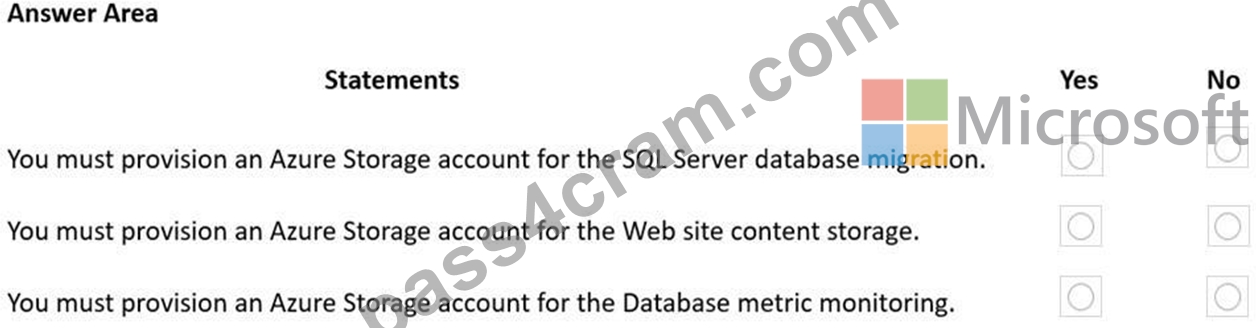
Answer:
Explanation: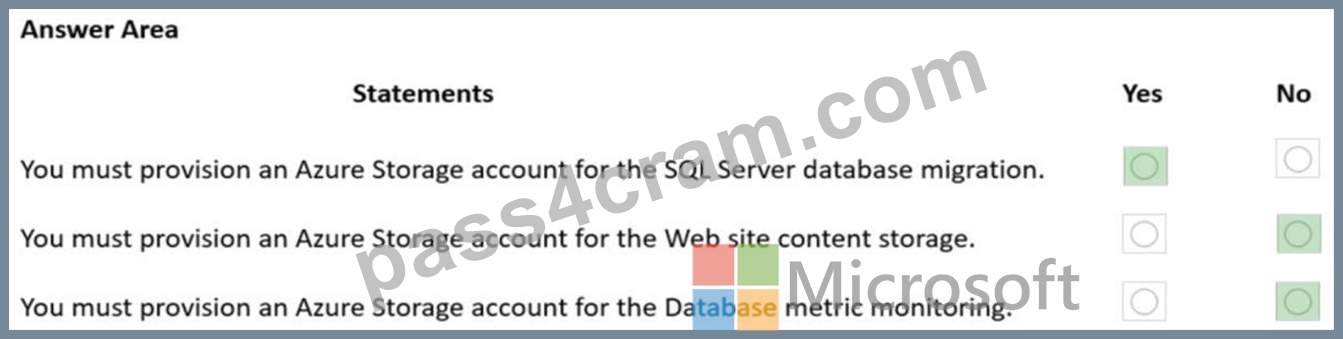
Explanation:
Box 1: Yes
Minimize downtime, so needs to be an online migration.
For online migrations from SQL Server to SQL Managed Instance using Azure Database Migration Service, you must provide the full database backup and subsequent log backups in the SMB network share that the service can use to migrate your databases.
When configuring the migration, you need to select the Azure Storage Account that DMS can upload the backup files from the SMB network share to and use for database migration. We recommend selecting the Storage Account in the same region as the DMS service for optimal file upload performance.
Box 2: No
Web site content must be easily updated from a single point -> Azure App Services Unpredictable workloads -> The Standard plan includes auto-scale which can automatically adjust the number of virtual machine instances running to match your traffic needs.
Box 3: No
You can stream SQL diagnostic telemetry to the following destinations:
- Log Analytics and SQL Analytics
- Event Hubs
- Azure Storage
Reference:
https://docs.microsoft.com/en-us/azure/azure-sql/virtual-machines/windows/migrate-to-vm-from- sql-server#choose-a-migration-method
https://docs.microsoft.com/en-us/azure/app-service/deploy-continuous-deployment?tabs=github
https://docs.microsoft.com/en-us/azure/azure-sql/database/monitor-tune-overview
NEW QUESTION # 121
You have 10 on-premises servers that run Windows Server.
You need to perform daily backups of the servers to a Recovery Services vault. The solution must meet the following requirements:
* Back up all the files and folders on the servers.
* Maintain three copies of the backups in Azure.
* Minimize costs.
What should you configure? To answer, select the appropriate options in the answer area.
NOTE: Each correct selection is worth one point.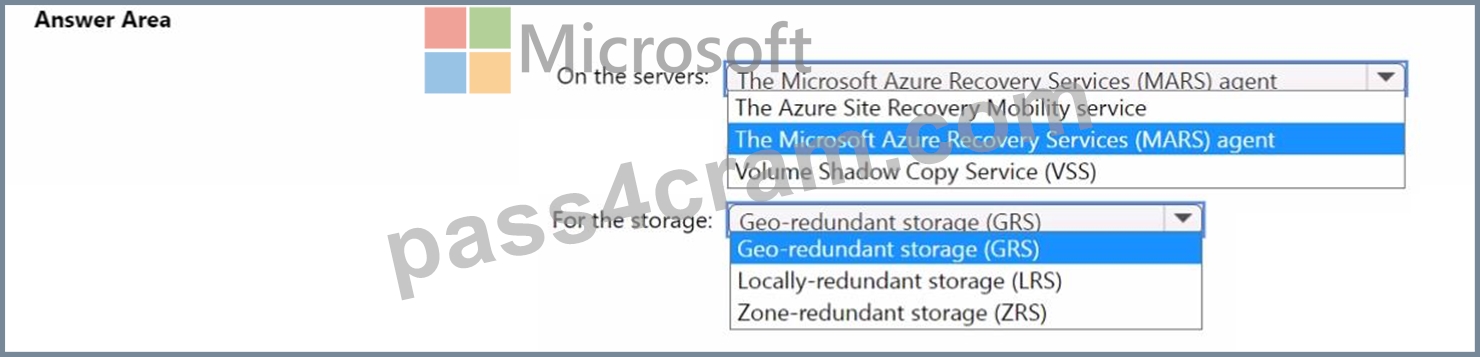
Answer:
Explanation: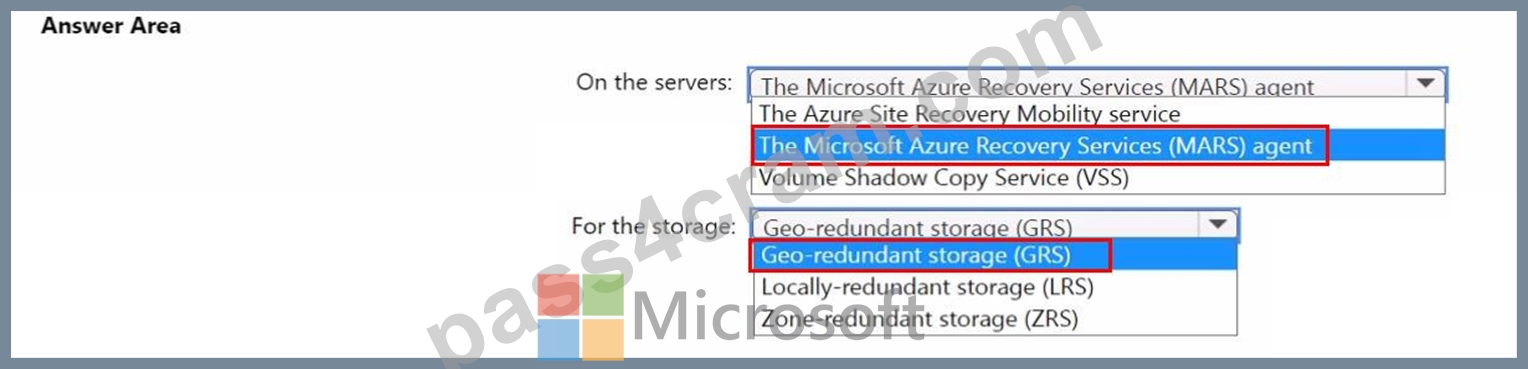
NEW QUESTION # 122
You have the Free edition of a hybrid Azure Active Directory (Azure AD) tenant. The tenant uses password hash synchronization.
You need to recommend a solution to meet the following requirements:
Prevent Active Directory domain user accounts from being locked out as the result of brute force attacks targeting Azure AD user accounts.
Block legacy authentication attempts to Azure AD integrated apps.
Minimize costs.
What should you recommend for each requirement? To answer, select the appropriate options in the answer area.
NOTE: Each correct selection is worth one point.
Answer:
Explanation:
Reference:
https://docs.microsoft.com/en-us/azure/active-directory/authentication/howto-password-smart-lockout
https://docs.microsoft.com/en-us/azure/active-directory/conditional-access/block-legacy-authentication
NEW QUESTION # 123
Your company has two on-premises sites in New York and Los Angeles and Azure virtual networks in the East US Azure region and the West US Azure region. Each on-premises site has Azure ExpressRoute circuits to both regions.
You need to recommend a solution that meets the following requirements:
Outbound traffic to the Internet from workloads hosted on the virtual networks must be routed through the closest available on-premises site.
If an on-premises site fails, traffic from the workloads on the virtual networks to the Internet must reroute automatically to the other site.
What should you include in the recommendation? To answer, select the appropriate options in the answer area.
NOTE: Each correct selection is worth one point.
Answer:
Explanation: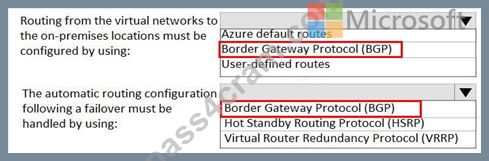
NEW QUESTION # 124
You have an Azure subscription that contains the SQL servers shown in the following table.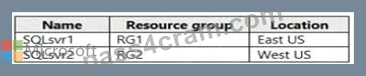
The subscription contains the storage accounts shown in the following table.
You create the Azure SQL databases shown in the following table.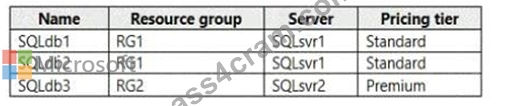
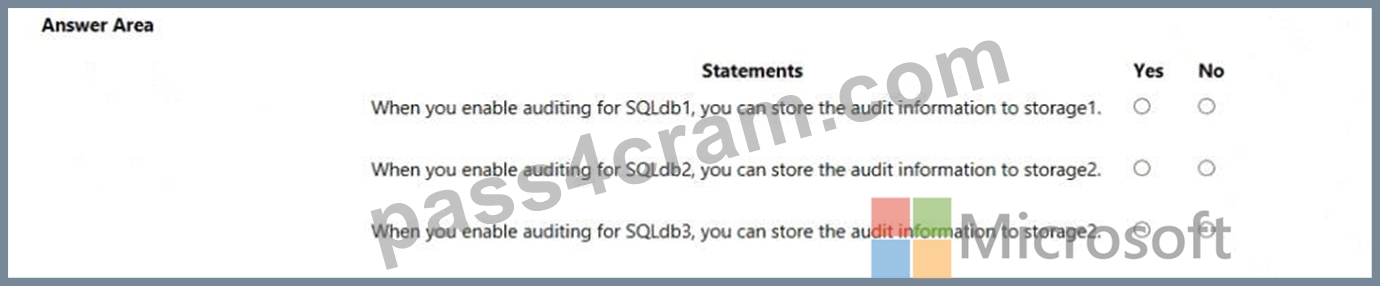
Answer:
Explanation: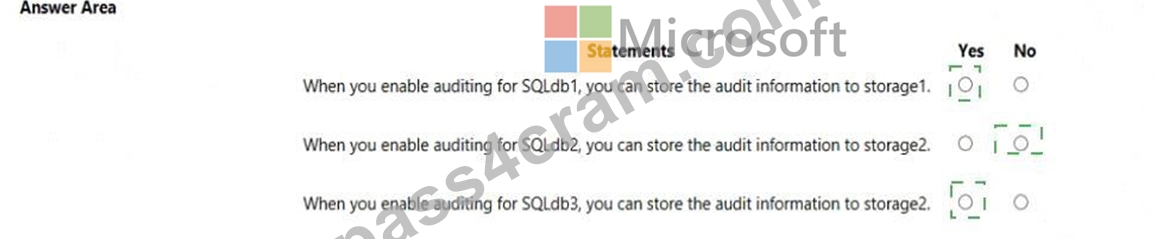
Explanation:
Box 1: Yes
Be sure that the destination is in the same region as your database and server.
Box 2: No
Box 3: Yes
https://docs.microsoft.com/en-us/azure/sql-database/sql-database-auditing Reference:
https://docs.microsoft.com/en-us/azure/sql-database/sql-database-auditing
https://docs.microsoft.com/en-us/previous-versions/azure/dn741340(v=azure.100)?redirectedfrom=MSDN
NEW QUESTION # 125
A company named Contoso, Ltd. has an Azure Active Directory (Azure AD) tenant that is integrated with Microsoft Office 365 and an Azure subscription.
Contoso has an on-premises identity infrastructure. The infrastructure includes servers that run Active Directory Domain Services (AD DS), and Azure AD Connect Contoso has a partnership with a company named Fabrikam, Inc. Fabrikam has an Active Directory forest and an Office 365 tenant. Fabrikam has the same on-premises identity infrastructure as Contoso.
A team of 10 developers from Fabrikam will work on an Azure solution that will be hosted in the Azure subscription of Contoso. The developers must be added to the Contributor role for a resource in the Contoso subscription.
You need to recommend a solution to ensure that Contoso can assign the role to the 10 Fabrikam developers. The solution must ensure that the Fabrikam developers use their existing credentials to access resources.
What should you recommend?
- A. Configure a forest trust between the on-premises Active Directory forests of Contoso and Fabrikam.
- B. Configure an organization relationship between the Office 365 tenants of Fabrikam and Contoso.
- C. In the Azure AD tenant of Contoso, use MIM to create guest accounts for the Fabrikam developers.
- D. Configure an AD FS relying party trust between the fabrikam and Contoso AD FS infrastructures.
Answer: A
Explanation:
Trust configurations - Configure trust from managed forests(s) or domain(s) to the administrative forest A one-way trust is required from production environment to the admin forest.
Selective authentication should be used to restrict accounts in the admin forest to only logging on to the appropriate production hosts.
Reference:
https://docs.microsoft.com/en-us/windows-server/identity/securing-privileged-access/securing-privileged-access-reference-material
NEW QUESTION # 126
You have two on-premises Microsoft SQL Server 2017 instances that host an Always On availability group named AG1. AG1 contains a single database named DB1.
You have an Azure subscription that contains a virtual machine named VM1VM1 runs Linux and contains a SQL Server 2019 instance.
You need to migrate DB1 to VMI. The solution must minimize downtime on DBI. What should you do? To answer, select the appropriate options in the answer area.
NOTE: Each correct selection is worth one point.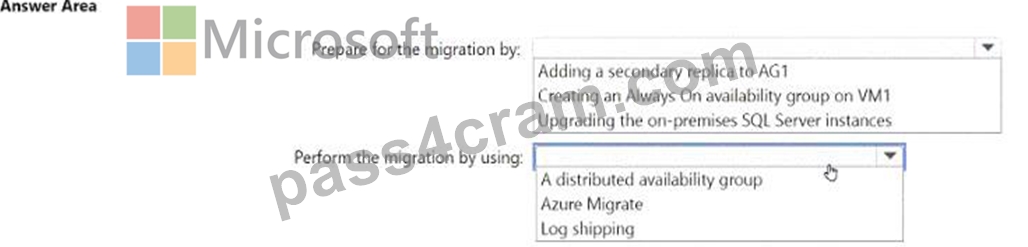
Answer:
Explanation: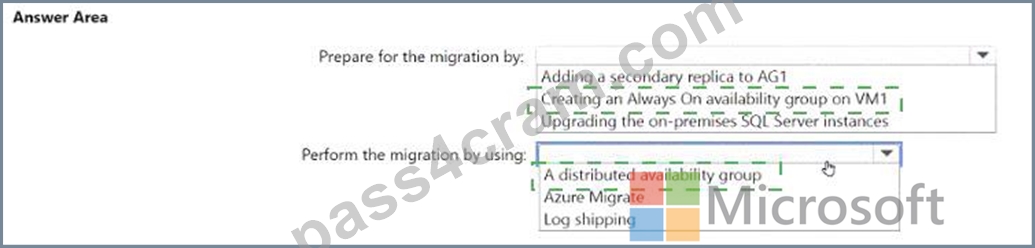
Explanation:
NEW QUESTION # 127
You plan to create an Azure Storage account that will host file shares. The shares will be accessed from on-premises applications that are transaction-intensive.
You need to recommend a solution to minimize latency when accessing the file shares. The solution must provide the highest-level of resiliency for the selected storage tier.
What should you include in the recommendation? To answer, select the appropriate options in the answer area.
NOTE: Each correct selection is worth one point.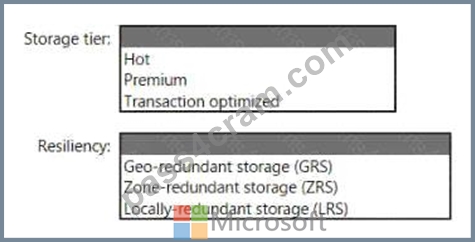
Answer:
Explanation: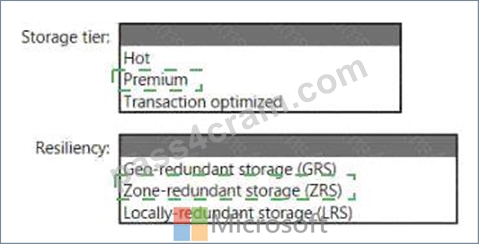
Explanation
Box 1: Premium
Premium: Premium file shares are backed by solid-state drives (SSDs) and provide consistent high performance and low latency, within single-digit milliseconds for most IO operations, for IO-intensive workloads.
Box 2: Zone-redundant storage (ZRS):
Premium Azure file shares only support LRS and ZRS.
Zone-redundant storage (ZRS): With ZRS, three copies of each file stored, however these copies are physically isolated in three distinct storage clusters in different Azure availability zones.
Reference:
https://docs.microsoft.com/en-us/azure/storage/files/storage-files-planning
NEW QUESTION # 128
You need to recommend a solution to integrate Azure Cosmos DB and Azure Synapse. The solution must meet the following requirements:
* Traffic from an Azure Synapse workspace to the Azure Cosmos D8 account must be sent via the Microsoft backbone network.
* Traffic from the Azure Synapse workspace to the Azure Cosmos DB account must NOT be routed over the internet.
* Implementation effort must be minimized.
What should you include in the recommendation? To answer, select the appropriate options in the answer area.
NOTE: Each correct selection is worth one point.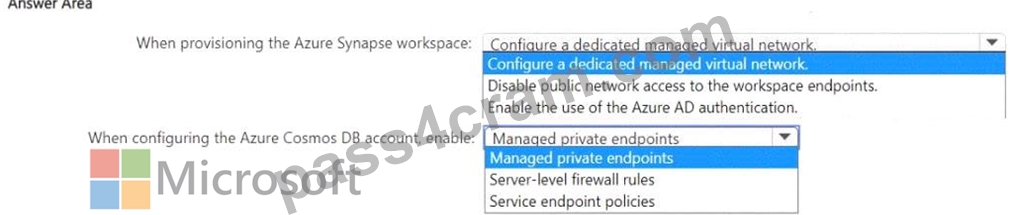
Answer:
Explanation: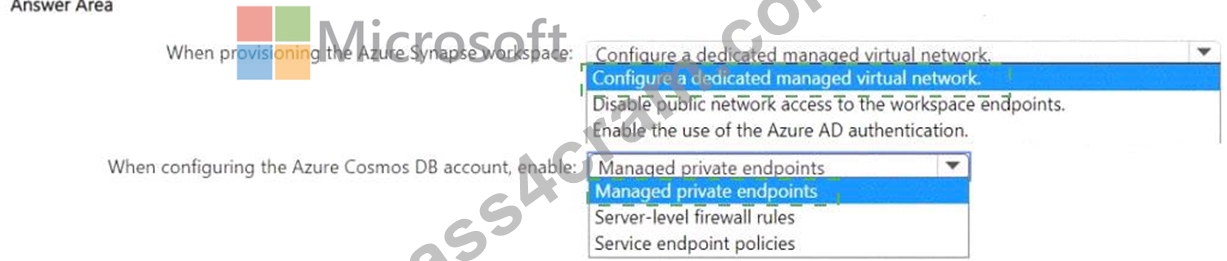
Explanation:
NEW QUESTION # 129
......
Achieve Success in Actual AZ-305 Exam AZ-305 Exam Dumps: https://www.pass4cram.com/AZ-305_free-download.html
Updated Microsoft Study Guide AZ-305 Dumps Questions: https://drive.google.com/open?id=1SSYEr0l3TgbmggpP93nEOE8S2fcAHLQl