


2025 Latest NCP-MCI-6.10 DUMPS Q&As with Explanations Verified & Correct Answers
NCP-MCI-6.10 dumps Exam Material with 121 Questions
NEW QUESTION # 16
What happens when a VM is associated with multiple VM-Host affinity policies?
- A. The oldest policy is applied
- B. All policies are applied simultaneously.
- C. The VM is automatically removed from all policies.
- D. The newest policy takes precedence.
Answer: D
NEW QUESTION # 17
An administrator using adark site deployment for LCMis attempting toupgrade to the latest BIOS.
After completing aninventory scan, the administrator doesnot see the expected BIOS versionavailable for upgrade.
What is the most likely reason the latest BIOS is not shown?
- A. The latest compatibility bundle has not been uploaded.
- B. The BMC version needs to be upgraded first.
- C. The dark site webserver is not accessible.
- D. AOS needs to be upgraded first.
Answer: A
Explanation:
In a dark site deployment, LCM does not automatically fetch updates from the internet. The administrator must manually upload compatibility bundles.
* Option B (The latest compatibility bundle has not been uploaded) is correct:
* Thecompatibility bundlecontainsfirmware mappings, allowing LCM to detect the correct BIOS version.
* Option A is incorrect:
* AOSdoes not need to be upgraded firstfor a BIOS update.
* Option C is incorrect:
* TheBMC firmware does not always need updatingbefore BIOS updates.
* Option D is incorrect:
* In a dark site deployment,LCM does not rely on an internet connection, so webserver access is not required.
References:
* Nutanix LCM Guide#Using Compatibility Bundles in Dark Sites
* Nutanix KB#Troubleshooting Firmware Updates in Dark Site Deployments
NEW QUESTION # 18 
LCM Framework Check
A Lcm prechecks detected 3 issues that would cause upgrade failures.
Check test lacp_configuration' failed: test_lacp_configuration: Unable to find Vcenter details for connection.
Please refer to KB 14277 Check test esx_ha_enabled' failed: Unable to find Vcenter details for connection Check test_es_entering_mm_pinned_vms' failed: Unable to find Vcenter details for connection X LCM Framework Check An administrator is attempting to upgrade the NIC firmware on a Nutanix cluster and sees the error displayed in the exhibit.
Which log is the most appropriate to analyze the LCM precheck failure?
- A. 1cm_ops.out
- B. catalog.out
- C. genesis.out
- D. 1cm_wget.out
Answer: A
Explanation:
The LCM (Life Cycle Manager) precheck failures in this scenario indicate an inability to connect to vCenter to validate ESXi-specific checks, such as LACP configuration, HA, and pinned VMs. The appropriate log to analyze the details of the LCM precheck failures is the 1cm_ops.out log.
From theNutanix Enterprise Cloud Administration (ECA)course materials:
"The 1cm_ops.out log file contains detailed output and error information related to LCM operations, including prechecks, execution, and post-checks. This log is essential for troubleshooting LCM framework failures and understanding the root cause of any issues preventing upgrades."
NEW QUESTION # 19
An administrator wants tolive-migrate a vGPU-enabled VMfrom one host to another within the same cluster.
What requirements must be met before initiating the migration?
- A. The target host has sufficient resources to support the VM.
- B. The VM must be configured as an agent VM.
- C. The vGPU profile needs to be changed.
- D. The host affinity for the VM must be set to a specific host.
Answer: A
Explanation:
vGPU-enabled VMs can only be migrated if the destination host has a compatible GPU and sufficient resources.
* Option A (Target host must have sufficient resources) is correct:
* The target hostmust have the same GPU model and enough available resourcesto support the VM.
* vGPUcannot be live-migrated across incompatible hardware.
* Option B (vGPU profile change) is incorrect:
* The profiledoes not need to be changedas long as the target host has the sameconfiguration.
* Option C (Agent VM required) is incorrect:
* Agent VMs are not necessaryfor vGPU migration.
* Option D (Host affinity) is incorrect:
* Host affinitylimits movement, butis not a prerequisite for migration.
References:
* Nutanix AHV Best Practices #Migrating vGPU-Enabled VMs
* Nutanix KB #Requirements for Live-Migrating vGPU VMs
NEW QUESTION # 20
A consultant is configuringsyslog monitoringand wants to receiveCRITICAL logsfrom theAudit module.
Which severity level setting should be configured to get the desired output?
- A. 0
- B. 1
- C. 2
- D. 3
Answer: D
Explanation:
Syslog severity levels follow a standard numerical system, wherelower numbers indicate higher severity.
* Option B (Severity Level 2) is correct:
* Level 2 = CRITICAL# Used forserious conditions requiring immediate attention.
* Audit logs often generate Critical logsrelated tosecurity, access violations, or major failures.
A screenshot of a computer Description automatically generated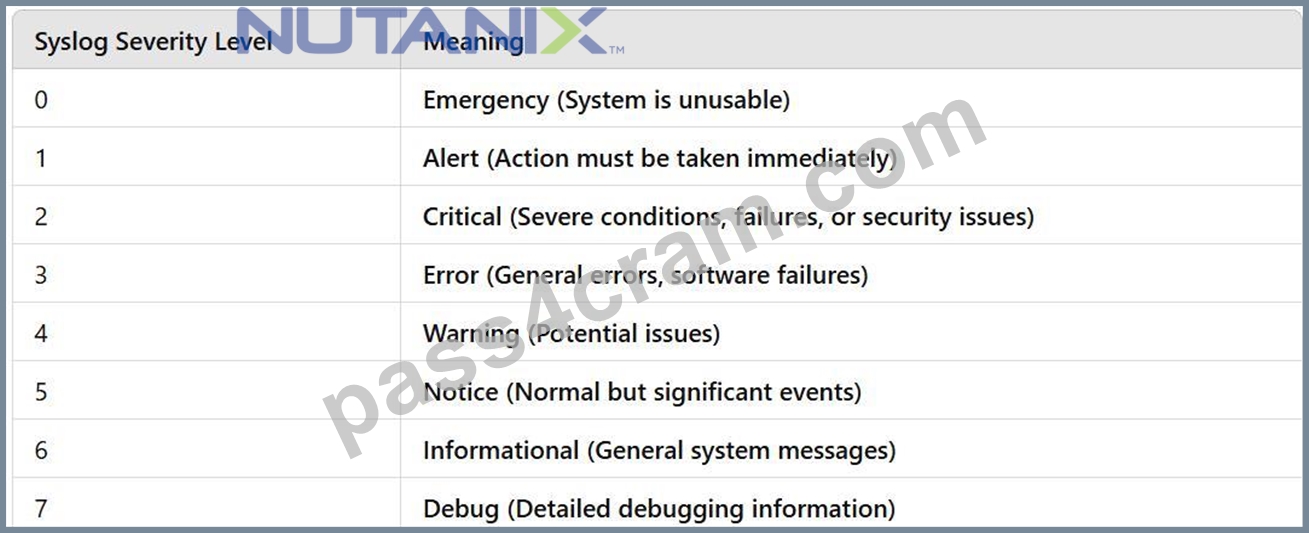
* Options A (0), C (5), and D (7) are incorrect:
* 0 = Emergency (Too severe, only used for full system failures).
* 5 = Notice (Not critical, used for general system events).
* 7 = Debug (Not relevant for critical logs).
References:
Nutanix Security Guide#Syslog Integration and Severity Levels
Nutanix KB#Configuring Syslog for Prism Central Audit Logs
NEW QUESTION # 21
Refer to Exhibit: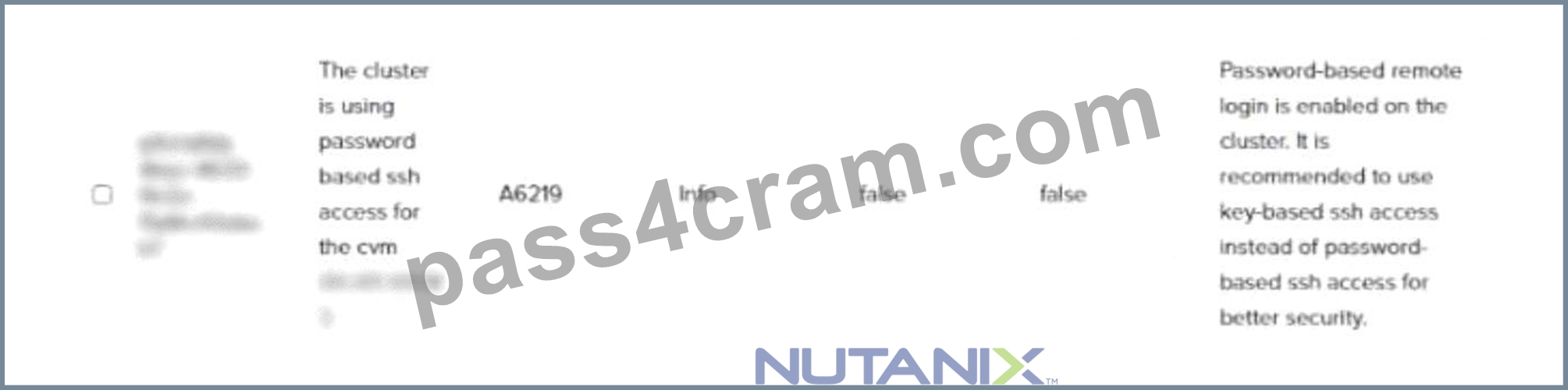
An administrator sees the alert shown in the exhibit.
What should the administrator do to ensure the nutanix user can no longer SSH to a CVM using a password?
- A. Enable Cluster Lockdown.
- B. Rename the nutanix user.
- C. Block port 22 on the CVM firewall.
- D. Delete the nutanix user.
Answer: A
Explanation:
Understanding the Exhibit & the Alert
The alert states:
* "The cluster is using password-based SSH access for the CVM."
* "Password-based remote login is enabled on the cluster."
* "It is recommended to use key-based SSH access instead of password-based SSH access for better security." This means that the nutanix user can log in to Controller VMs (CVMs) using a password, which is a security risk.
Corrective Action: Enabling Cluster Lockdown
#(C) Enable Cluster Lockdown. (Correct Answer)
* Cluster Lockdown Mode restricts password-based SSH access and forces key-based authentication.
* This prevents users from logging into CVMs using passwords, enhancing cluster security.
* To enable Cluster Lockdown:
* Go to Prism Central or Prism Element.
* Navigate to Settings # Security # Cluster Lockdown.
* Enable Cluster Lockdown Mode.
Evaluating the Other Answer Choices
#(A) Rename the nutanix user. (Incorrect)
* The nutanix user is a built-in system account required for cluster operations.
* Renaming the user will not prevent SSH access via password.
#(B) Block port 22 on the CVM firewall. (Incorrect)
* Blocking port 22 (SSH) will completely disable SSH access, including key-based authentication.
* This may break cluster management and troubleshooting operations.
#(D) Delete the nutanix user. (Incorrect)
* The nutanix user is a critical system account required for cluster functionality.
* Deleting the account will cause serious issues with cluster management.
Multicloud Infrastructure References & Best Practices
* Nutanix Security Best Practices:
* Always use key-based SSH authentication instead of password-based logins.
* Enable Cluster Lockdown Mode to enforce security policies.
* Regularly audit user access to ensure security compliance.
* Cluster Lockdown Benefits:
* Prevents unauthorized SSH access via passwords.
* Enforces public key authentication, reducing brute-force attack risks.
* Strengthens CVM security against potential exploits.
References:
* Nutanix Security Guide #Enabling Cluster Lockdown for SSH Security
* Nutanix KB #Securing SSH Access on Nutanix Clusters
NEW QUESTION # 22
An administrator attempted toenable Data-in-Transit Encryptionon aScale-Out Prism Central clusterto encrypt service-level traffic between nodes. However, the featuredid not work correctly due to a firewall restriction.
Which CVM-specific port should be allowed through the firewall for Data-in-Transit Encryption?
- A. 0
- B. 1
- C. 2
- D. 3
Answer: D
Explanation:
Data-in-Transit Encryption in Nutanix requires inter-node communication over specific CVM ports.
* Option A (Port 2009) is correct:
* Port2009 is used for Data-in-Transit Encryption between Nutanix CVMs.
* Firewall rules must allow traffic on this portto enable secure encrypted communication.
* Option B (Port 2010) is incorrect:
* Port2010 is used for CVM-to-CVM communication but does not handle encryption.
* Option C (Port 2020) is incorrect:
* This port is used forAcropolis File Services (AFS), not encryption.
* Option D (Port 9440) is incorrect:
* Port9440 is used for Prism Central web access, not internal CVM encryption.
References:
* Nutanix Security Guide#Data-at-Rest vs. Data-in-Transit Encryption
* Nutanix KB#Firewall Port Requirements for Secure Cluster Communication
NEW QUESTION # 23
An administrator isprotecting an application and its datastored onVolume GroupsusingProtection Domains.
Duringfailover tests, allapplication VMs restore successfully, but theapplication data is completely missing.
How can the Protection Domain configuration be adjusted to avoid this issue in the future? (Choose two.)
- A. Use application-consistent snapshots.
- B. Select the "Auto protect related entities" checkbox.
- C. Place Volume Groups in a separate Protection Domain.
- D. Manually add Volume Groups to Protected Entities.
Answer: B,D
Explanation:
Protection Domains (PDs) in Nutanix ensure that entire applications and their associated data are protected during failover.However,Volume Groups (VGs) are not automatically includedunless explicitly configured.
* Option A (Select "Auto protect related entities") is correct:
* This setting ensures thatassociated Volume Groups, networks, and other dependencies are included in the Protection Domainautomatically.
* Without enabling this, only the VM itself would be protected, leading tomissing application data upon failover.
* Option B (Manually add Volume Groups to Protected Entities) is correct:
* If"Auto protect related entities" is not enabled, the administrator mustmanually add Volume Groups to the Protection Domain.
* This ensures that bothVMs and their attached Volume Groupsare replicated and recovered together.
* Option C (Place Volume Groups in a separate Protection Domain) is incorrect:
* Separating Volume Groups into a different PDdoes not guarantee they failover together with VMs.
* It is best practice tokeep related VMs and Volume Groups in the same PD.
* Option D (Use application-consistent snapshots) is incorrect:
* Whileapplication-consistent snapshots improve data integrity, theydo not fix missing Volume Groups in failover scenarios.
References:
* Nutanix Disaster Recovery Guide#Protection Domain Configuration and Volume Groups
* Nutanix KB#Ensuring Volume Groups Are Included in Disaster Recovery Failovers
NEW QUESTION # 24
In anRF2 cluster, what is theminimum number of nodes requiredto allow ahost removal?
- A. 0
- B. 1
- C. 2
- D. 3
Answer: D
Explanation:
Replication Factor (RF2) means that each piece of data is stored twice across different nodes to ensure availability.
* Option B (3 nodes) is correct:
* In anRF2 cluster, data redundancy requires at leastthree nodestoensure data protectionwhen one node is removed.
* If a node is removed from a3-node cluster, Nutanix automatically redistributes data across the remaining nodes.
* Option A (2 nodes) is incorrect:
* RF2 requiresat least three nodesto maintainfault tolerance.
* A2-node cluster cannot provide full redundancywithout a Witness node.
* Option C (4 nodes) and Option D (5 nodes) are incorrect:
* While larger clusters provide more redundancy, theminimum requirement is 3 nodes.
References:
* Nutanix Bible #Replication Factor (RF) and Fault Tolerance
* Nutanix Prism Element Guide #Managing Node Failures and Removals
NEW QUESTION # 25
An administrator is working with anetwork engineerto design thenetwork architecture for a DR failover.
BecauseDNS is well-designed, theDR site will use a different subnetbutretain the same last octetin the IP address.
What is the best way to achieve this?
- A. Set up IPAM so the address is dynamically assigned during DR.
- B. Utilize Recovery Plan Offset-based IP mapping.
- C. Manually log into VMs after the DR event and update the last octet.
- D. Use a custom script to update the IP address after instantiation in DR.
Answer: B
Explanation:
Offset-based IP mapping in Nutanix Recovery Plans allows automatic subnet changes during DR failover.
* Option D (Utilize Recovery Plan Offset-based IP mapping) is correct:
* This methodautomatically adjusts the IP rangewhile keeping the same last octet.
* It eliminates the need formanual interventionafter failover.
* Option A (Custom script) is incorrect:
* Scripting is an option, butRecovery Plan IP mapping is simpler and native to Nutanix.
* Option B (Use IPAM) is incorrect:
* IP Address Management (IPAM) is useful, butoffset-based mapping provides more control.
* Option C (Manually update IPs) is incorrect:
* This would betime-consuming and error-prone.
References:
* Nutanix Disaster Recovery Guide #Using Offset-Based IP Mapping
* Nutanix KB #Best Practices for Managing IP Addresses in DR
NEW QUESTION # 26
When expanding acluster, what is required toautomatically discover new nodes?
- A. IPv4 multicast must be allowed on physical switches.
- B. New nodes must have the same hypervisor version.
- C. New nodes must have the same AOS version.
- D. IPv6 multicast must be allowed on physical switches.
Answer: A
Explanation:
Nutanix uses IPv4 multicast for automatic node discovery and cluster expansion.
* Option D (IPv4 multicast must be allowed) is correct:
* When adding new nodes,the Nutanix Cluster automatically detects themusingIPv4 multicast traffic.
* If multicast isblocked at the switch level, the new nodeswill not be discoveredautomatically.
* Option A (Hypervisor version must match) is incorrect:
* While thehypervisor version should be compatible, itdoes not impact node discovery.
* Option B (IPv6 multicast) is incorrect:
* Nutanixdoes not use IPv6 multicast for cluster discovery.
* Option C (AOS version must match) is incorrect:
* Nodes can haveslightly different AOS versions, butdiscovery still works as long as they are compatible.
References:
* Nutanix Best Practices #Cluster Expansion & Auto-Discovery
* Nutanix KB #Why Nutanix Requires IPv4 Multicast for Node Discovery
NEW QUESTION # 27
The customer expects to maintain a cluster runway of 9 months. The customer doesn't have a budget for 6 months but they want to add new workloads to the existing cluster.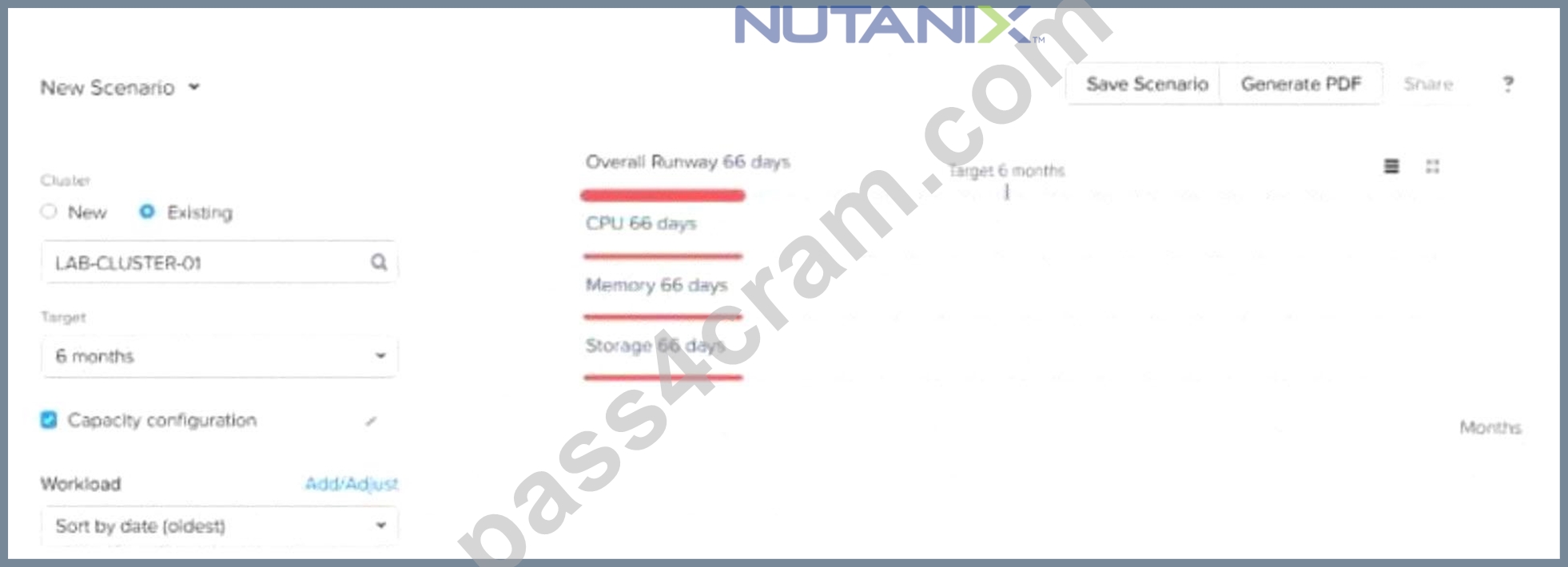
Based on the exhibit, what is required to meet the customer's budgetary timeframe?
- A. Delete workloads running on the cluster.
- B. Add resources to the cluster.
- C. Postpone the start of new workloads.
- D. Change the target to 9 months.
Answer: B
Explanation:
The exhibit shows that theoverall runway is only 66 days, meaning that the current clusterdoes not have enough capacity to sustain workloads for 6 months, let alone 9 months.
* The best solution is toadd resources to the cluster(Option A), such as CPU, memory, or storage, to extend the runway.
* Postponing new workloads(Option B) may help in the short term but does not align with the business need to continue adding workloads.
* Deleting workloads(Option C) is not a viable option because the customer wants to add more, not remove them.
* Changing the target to 9 months(Option D) does not change the actual resource constraints; it only alters the target timeframe.
References:
* Nutanix Prism Central # Capacity Planning and Runway Analysis
* Nutanix Bible # Cluster Resource Management and Scaling
* Nutanix Support KB # How to Extend Cluster Runway with Resource Scaling
NEW QUESTION # 28
Upon reaching the maximum instances of retained reports, what occurs?
- A. Manual deletion is required.
- B. Oldest report is deleted
- C. Reporting failure is reported.
- D. New reporting is delayed.
Answer: B
Explanation:
When the maximum instance count of retained reports is reached, Nutanix automatically deletes the oldest report to accommodate the new one.
From theNutanix Enterprise Cloud Administration (ECA)course materials:
"To ensure storage and performance efficiency, Nutanix reporting limits the number of stored reports. If this maximum is reached, the oldest report instance is automatically deleted to make space for new reports."
NEW QUESTION # 29
A security team asks an administrator toset up port mirroringof aspecific source VMto atarget VM.
What must the administrator ensure for this configuration to be possible?
- A. Source VM and Target VM are on the same VLAN.
- B. Source VM and Target VM are on the same subnet.
- C. Source VM and Target VM are on the same VPC.
- D. Source VM and Target VM are on the same host.
Answer: D
Explanation:
Port mirroring requires the source and target VMs to be on the same host to efficiently copy network traffic without additional routing overhead.
* Option B (Source VM and Target VM are on the same host) is correct:
* AHV's port mirroringonly works within a single hostbecause network packets are intercepted before leaving the hypervisor.
* If the VMs are on different hosts,mirroring cannot be configured without additional network tools.
* Option A (Same VLAN) is incorrect:
* VLAN membership isnot a requirementfor port mirroring.
* Option C (Same subnet) is incorrect:
* Port mirroring happens atthe virtual switch level, which does not require VMs to be in the same subnet.
* Option D (Same VPC) is incorrect:
* While VPCs provide network isolation,they do not control port mirroring availability.
References:
* Nutanix AHV Networking Guide #Configuring Port Mirroring in AHV
* Nutanix KB #Port Mirroring Best Practices
NEW QUESTION # 30
An administrator is receiving repeated approval requests to delete a protected snapshot that has already been approved.
What is the likely cause?
- A. There are multiple approvers on the approval policy.
- B. The administrator is an approver on the approval policy.
- C. There is an error with the SMTP server.
- D. The Policy Engine wasn't implemented.
Answer: B
Explanation:
In Nutanix Prism Central, if anadministrator is also an approverfor an approval policy, it can result in repeated prompts for approvals even after the original request is approved. This occurs because the system requires the approver (who is also the requester) to explicitly confirm actions involving protected snapshots to maintain compliance and avoid accidental deletion.
From theNutanix ECA documentation:
"When an administrator is configured as an approver in the approval policy, repeated approval requests may occur because the same user must explicitly confirm actions they initiated, such as deleting protected snapshots. This ensures administrative actions are fully deliberate."
NEW QUESTION # 31
An administrator has deployed two Nutanix clusters and is now establishing synchronous replication between them. However, the replication is failing immediately.
Which two responses show the reason and corrective action an administrator can take to resolve the issue?
(Choose two.)
- A. If the primary and the recovery clusters are in different subnets, open the ports manually for communication.
- B. If the primary and the recovery clusters are on the same subnet, open the ports manually for communication.
- C. Use the command modify_firewall to open the ports on eth1 interface.
- D. Use the command modify_firewall to open the ports on eth0 interface
Answer: A,C
Explanation:
When synchronous replication fails immediately between two clusters, it is often due to blocked communication across the required ports (2009 and 2020). These must be open manually if the clusters are in different subnets or if network policies block traffic.
From theNutanix Enterprise Cloud Administration (ECA)course materials:
"Replication communication relies on specific ports, which must be allowed through the firewall. If the clusters are in different subnets or if there are external firewalls, these ports must be explicitly opened."
"The modify_firewall command is used to open or close ports on cluster nodes. For replication and remote site communication, eth1 is typically used for external replication traffic." Since eth1 is typically used for external connectivity and replication traffic, opening ports on this interface using modify_firewall resolves the communication block.
NEW QUESTION # 32
An administrator wants todisable password-based SSH accessfor thenutanix useron aCVMto improve security.
What action should the administrator take?
- A. Blockport 22on the CVM firewall.
- B. Rename thenutanix user.
- C. Delete thenutanix user.
- D. EnableCluster Lockdown.
Answer: D
Explanation:
Enabling "Cluster Lockdown" in Nutanix is the best security measure to prevent password-based SSH logins.
* Option C (Enable Cluster Lockdown) is correct:
* Cluster Lockdowndisables password-based SSHandrequires key-based authentication.
* Option A (Rename the nutanix user) is incorrect:
* The Nutanix useris a system accountand cannot be renamed.
* Option B (Block port 22) is incorrect:
* This wouldprevent all SSH connections, includingkey-based logins, making administration difficult.
* Option D (Delete the nutanix user) is incorrect:
* Thenutanix useris required for system operations and cannot be removed.
References:
* Nutanix Security Guide #Implementing Cluster Lockdown
* Nutanix KB #Best Practices for SSH Security on CVMs
NEW QUESTION # 33
A Disaster Recovery administrator has setup a Protection Policy for 50 workloads - all configured in a similar fashion in terms of OS, storage, network, and performance. The RPO is 60 minutes with a specified retention of 10 copies local, 5 copies remote, and crash consistency.
After configuring the Protection Policy and activating it, the administrator has noticed that recovery points are not showing up in DR. Yet, everything within the Protection Policy looks correct and recovery points are showing up on production side.
What is the most likely issue?
- A. Nutanix NGT is not installed on the source VMs.
- B. Windows updates need to be run on all the affected VMs.
- C. The storage container name of the protected VMs is not the same as the DR cluster storage container
- D. The storage container RF factor of the protected VMs is not the same as the RF factor in the DR cluster container.
Answer: D
Explanation:
In Nutanix Protection Domain-based replication, both thesourceanddestinationstorage containersmust have the same Replication Factor (RF)to ensure consistent data protection and replication. This is a key requirement for the data's protection and integrity.
From theNutanix ECAdocumentation:
"Replication and recovery require that the source and destination containers have the same RF setting (either RF2 or RF3). If the RF does not match, replication and recovery points will not be generated in the DR site." The other options:
* A (NGT): NGT is not required for crash-consistent protection.
* C (Windows updates): Updates are not directly relevant to replication consistency.
* D (container name): Names can differ; what matters is the container's RF setting.
NEW QUESTION # 34
Refer to Exhibit: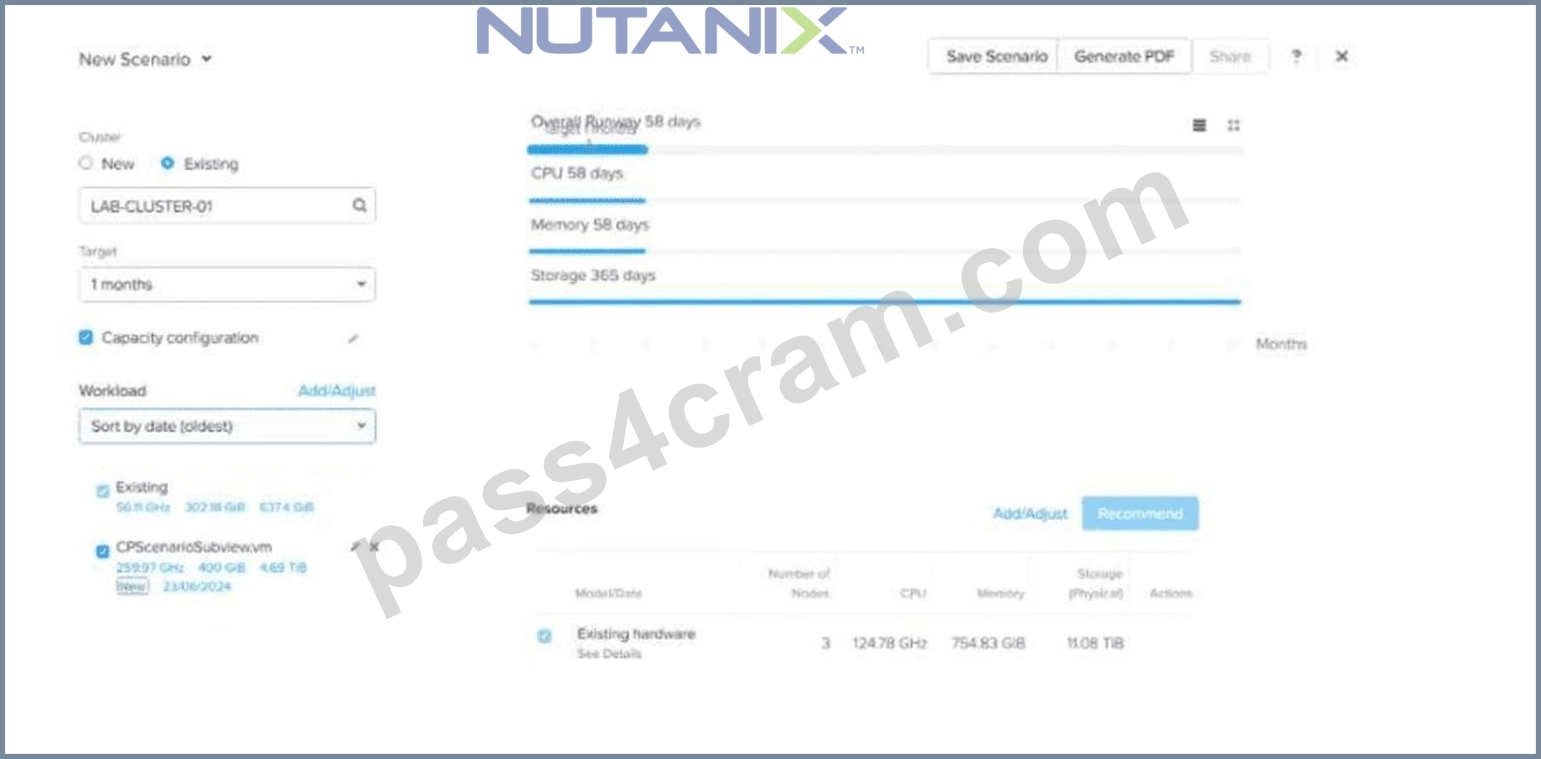
After adding new workloads, why isOverall Runway below 365 daysand the scenario still shows the cluster is in good shape?
- A. Because the Target is 1 month.
- B. Because new workloads are sustainable.
- C. Because there are recommended resources.
- D. Because Storage Runway is still good.
Answer: B
Explanation:
InNutanix Capacity Planning,Overall Runwayrepresents how long the cluster can support current and new workloads before resources are exhausted.
* Even if the runway is below 365 days, the system considers the cluster to be in good shape if new workloads are sustainable (Option B).
* Option A is incorrect: Storage runway alone is not the only factor; CPU and memory are equally important.
* Option C is incorrect: The presence of recommended resources does not mean the cluster is in good shape.
* Option D is incorrect: The target of 1 month affects projections but does not explain why the cluster is in good shape.
References:
Nutanix Prism Central # Capacity Runway and Planning
Nutanix Bible # Workload Placement and Cluster Sizing
Nutanix Support KB # Capacity Planning Best Practices
NEW QUESTION # 35
......
Nutanix NCP-MCI-6.10 Exam Syllabus Topics:
| Topic | Details |
|---|---|
| Topic 1 |
|
| Topic 2 |
|
| Topic 3 |
|
| Topic 4 |
|
| Topic 5 |
|
Share Latest NCP-MCI-6.10 DUMP Questions and Answers: https://www.pass4cram.com/NCP-MCI-6.10_free-download.html
NCP-MCI-6.10 Questions and Answers Guarantee you Oass the Test Easily: https://drive.google.com/open?id=13q6Gb3NW3d4alb4HLI6TR0dpDLy_Wro_